Category: Non-Video

  • California launches first dairy digester pipeline cluster

    CDFA Undersecretary Jenny Lester Moffitt congratulates Calgren and their partner dairies and contractors at the launch of the new digester cluster facility.

    California is proud to announce the state’s first dairy digester pipeline cluster. CDFA Undersecretary Jenny Lester Moffitt was on-hand this week for the launch of Calgren Renewable Fuels’ new facility, which partners with local dairies in the Pixley, California area.

    Eleven digesters, 22 miles of pipeline and 75,000 cows contribute to this interconnected system, which will collectively reduce an estimated of 1,867,651 metric tons of CO2 (equivalent) over 10 years. That’s equal to 399,925 passenger vehicles driven for 1 year or 201,668 homes’ electricity use for 1 year. Now that’s cow power.

    Touring the Calgren facility.

    The digesters and the cluster project were made possible in part by grants in 2017 and 2018 from CDFA’s Dairy Digester Research and Development Program totaling approximately $16 million, with an additional $17.5 million in matching funds provided by the dairies and Calgren.

  • California Dairy Digital Magazine: October 2018 Issue

    Bordessa Dairy Featured In Scaling Up Climate Smart Ag Event
    Producers, Officials Discuss Role of Ag in Creating Solutions

    Changing Manure Management to Reduce Dairy Methane Emissions
    Detailed Study Provides “Whole Dairy” Methane Analysis in CA

    Dairy Safety 101
    Revisiting Dairy Hazard Prevention

    CA Federal Milk Marketing Order Implementation Underway
    CDFA Sets Final Prices – Up from September
  • FDA’s “Intentional Adulteration” Rule

    Don’t Get Behind

    As with many of FDA’s new rules that are part of the Food Safety Modernization Act, the Intentional Adulteration rule sets a standard for the industry that’s similar to what many food processors already have in place.  Companies which have a GFSI certification, like SQF or BRC, already have something called a “Food Defense” plan that includes consideration of facility security measures such as locking doors, fences, security cameras, protection of digital resources, design of processing equipment, and even mail controls.

    However even if this is you, don’t assume that your programs already meet the requirements of the rule; there are some new requirements to consider.  And of course, if your company still doesn’t have a food defense program you should take a serious look at what this rule expects from processors.

    First, the Basics

    This rule, as with the Preventive Controls rule, applies to most companies who are required to register with FDA as a food processor –the majority of the food processing industry.  This includes both domestic companies, and those foreign companies whose product is sold in the U.S.  For readers that import products into the U.S., take note!  Part of your “Foreign Supplier Verification Program” may soon need to include verifying that food defense controls are in place at your supplier’s facility.


    In true FSMA fashion, compliance dates are staggered based on Company size:

    Company Size Compliance Date
    Very small businesses:

    Less than $10 Million in total manufactured, processed, packed, or held

    July 2021
    Small Businesses:

    Less than 500 FTE Employees

    July 2020
    All Others July 2019


    The rule’s requirements can be summarized as follows:

    • Develop a food defense plan
    • Conduct an assessment of potential risks to product from intentional adulteration. Adulteration may be committed by trespassers, visitors, or even employees.
    • Determine mitigation strategies (controls to reduce risk)
    • Implement the plan
      • Train employees
      • Implement mitigation strategies
      • Monitor control measures
      • Apply corrective actions where needed
      • Verify the plan and its controls
    • Reanalyze the plan periodically

    What’s New or Different from GFSI?

    In previous years food defense has been managed much like GMPs: companies would use a standard checklistto assess their facility controls, much like the tool from FSIS used by many manufacturers. While these tools are helpful, they don’t meet the new requirements that FDA has developed.

    Under this rule, FDA will expect to see a more robust program, similar to a HACCP-based approach.  A full assessment of the facility and each process step will need to be done just like a HACCP plan:

    1. Assemble a food defense team
    2. Describe the product under evaluation
    3. Develop a process flow diagram
    4. Describe the process steps
    5. Assess risk at each step based on 3 factors:
      1. Severity of potential public health impact
      2. Degree of access to product
      3. Ability to successfully contaminate product
    6. Identify & implement mitigation strategies
    7. Monitor mitigation strategies
    8. Apply corrective actions as needed
    9. Verification of the program


    With regard to processing steps, the FDA has already provided guidance that there are a few key activity types considered high risk, which they will expect food processors to focus on in their facilities:

    • Receiving and loading of bulk liquid ingredients / raw materials
    • Liquid storage and handling processes
    • Secondary ingredient handling (any point where dry or liquid ingredients are handled or manipulated)
    • Mixing, grinding, and similar activities


    As you can see based on the above, FDA’s perspective is that when ingredients or products are handled and processed in bulk there is a greater risk.  But aside from this, it is each processors’ job to conduct a full assessment of all their processes and identify controls needed at any step.

    Available Guidance and Tools

    There are a variety of tools that FDA has made available for the industry; the difficulty is sifting through all of the information they’ve provided, as it can be overwhelming.  Here are a few key items we recommend:

    • FDA has published an excellent guidanceon the rule and has more guidance planned in the future. You can sign up for email updates on FSMA on their website.
    • The FDA’s “Food Defense Plan Builder” is a piece of software that can be downloaded and used to build a compliant program.
    • FDA has provided a short trainingthat can be taken by front-line employees to help them understand regulatory requirements andassist their company in meet the training requirements.
    • The Food Safety Preventive Controls Alliance (FSPCA) has various types of trainingavailable in various formats, for members of management involved in developing food defense programs.


    This article was written by Jon Kimble of the Safe Food Alliance.

    https://safefoodalliance.com/newsletter/2018-09/fdas-intentional-adulteration-rule/

  • Presidential Order Restores Western Water Supplies

    Today’s order by President Trump will provide welcome relief to Western farmers, cities, rural communities and wildlife refuges that have struggled under water supply rules that are long overdue for an update. Prioritizing national interest and the value of California food production, the president’s order requires the re-consultation of the biological opinions to be completed and fully implemented by August 2019. The deadline will bring to a close the review of rules governing the long-term operation of the federal Central Valley Project and California State Water Project. The review has been underway since August 2016, a process today’s order requires to be concluded by Aug. 31, 2019.

    The president’s action today fulfills his campaign commitment to help solve the state’s water supply shortages and will greatly benefit Central Valley communities and the environment. Since 1992, water supply restrictions have caused severe economic consequences for farms and the people who depend on them for work. Many of the state’s most disadvantaged communities have suffered due to scarce water supplies. Wildlife refuges that are a critical component of the Pacific Flyway have had insufficient water to meet the needs of millions of ducks, geese, shorebirds, songbirds and endangered animals in large parts of the Central Valley and the Klamath Basin. An ongoing review of the rules governing these critical water supplies only delays the ability of these important areas to recover.

    This action will also help address water shortages that have occurred across the West as the result of federal regulations overseen by multiple agencies. It offers hope to farmers and ranchers served by federal water projects in the Pacific Northwest, including the Columbia Basin and the Klamath Basin. The president’s order places the responsibility of operating the federal water projects with the Department of the Interior, to be supported by the National Marine Fisheries Service and the U.S. Fish and Wildlife Service. The action prohibits any impacts to threatened or endangered species protected under the federal Endangered Species Act.

    This issue has been scrutinized by the Executive Branch as far back as 2011. At that time, President Obama observed that the Interior Department is in charge of salmon while they’re in freshwater, but the Commerce Department handles them when they’re in saltwater. Those overlapping jurisdictions have only slowed efforts to help the fish.

    A committee convened by the National Research Council also studied this matter a few years ago. The NRC found that the lack of a systematic, well-framed overall analysis between the two services is “a serious scientific deficiency, and it likely is related to the ESA’s practical limitations as to the scope of actions that can or must be considered in a single biological opinion.”

    Improved coordination between federal agencies will promote more efficient, effective and coordinated management of all ESA responsibilities for anadromous and freshwater fish in Western watersheds, from the highest reaches of our headwaters to the Pacific Ocean.

    “This action is an important and common-sense move that will benefit Western farmers and ranchers whose livelihoods depend on federal water projects,” said Dan Keppen, executive director of the Family Farm Alliance. “It’s a practical and assertive change to Western water management and species recovery that our membership strongly supports.”

    California’s GOP congressional delegation from the Central Valley played an important role in identifying the problems in the state’s water system and worked closely with the Trump administration to produce a solution that is consistent with federal law and will improve the water delivery system.

    “There’s no question that the Central Valley has lagged behind the economic recovery experienced in other parts of the state. We’re optimistic that these changes will not only help improve water supplies for farms, farm-related businesses, and disadvantaged rural communities, they will provide the incentive to put science-based solutions to work to help recover iconic native fish species that have suffered under the existing regulatory approach,” said Mike Wade, executive director of the California Farm Water Coalition.

    “This is a common-sense improvement to a process that has been abused in the past by regulatory agencies seeking to impose a scientifically-unsound regime on water users that ultimately, by design, de-irrigates some of the highest quality farmland in the world. This move by the Administration simply ensures that the process of revising the rules governing Delta water operations will be less vulnerable to regulatory abuse,” said Tom Nassif, president of the Western Growers Association.

    “Implementation of the Endangered Species Act can be better for both species and people, and the president’s action moves us in that direction,” California Farm Bureau Federation President Jamie Johansson said. “It’s time to grow beyond the culture of conflict that has governed California water for too long. We need streamlined solutions that benefit species and that benefit both the farmers who provide California-grown food and farm products and everyone who depends on those products.”

    Manuel Cunha, Jr., President of the Nisei Farmers League shared, “We want to thank President Trump, Congressman Devin Nunes and the entire Valley delegation for their efforts that will improve the lives of many, especially in the San Joaquin Valley. There will be a strict timetable for rewriting the biological opinion that caused millions of acre feet of water that would have been used in the San Joaquin Valley to be flushed out to the ocean. This action prioritizes building water storage projects that are badly needed. ​It is a good day for California, for our hard-working families,and for our communities.

    [layerslider id=”6″]

  • Testing Your Product for Glyphosate

    Glyphosate: In the News

    Chances are you’ve been hearing a lot in the news recently about glyphosate, the active ingredient in the herbicide and plant growth regulator Roundup®.

    In early August, a jury awarded $289 million to a former groundskeeper who claimed that exposure to Roundup® caused his non-Hodgkin’s lymphoma. This heavily publicized case was quickly followed by a report from the Environmental Working Group (EWG), which found that 31 out of 45 of the conventionally grown cereals being tested “…had glyphosate levels higher than what EWG scientists consider protective of children’s health with an adequate margin of safety”.

    According to the EWG report, glyphosate levels in cereals must remain under 0.01 milligrams or a concentration of 160 ppb (part-per-billion). Levels above this benchmark standard were reported to cause increased health concerns for consumers.

    The EWG report authors reached a consumption limit of 0.01 milligrams per day by applying a 100x safety factor to California’s Proposition 65 No Significant Risk Level (NSRL) for glyphosate (1.1 mg/day). This NSRL under Prop. 65 itself represents a more than a 100x reduction from the acceptable daily intakes (ADIs) set by both the United States Environmental Protection Agency (EPA) and the World Health Organization (WHO) after their reviews of the toxicity data for glyphosate. In other words, the Environmental Working Group set a “safety limit” that was 10,000-fold below the risk-based limits set by EPA and WHO!

    The European Commission is famously cautious when it comes to setting pesticide residue limits. Even using the safe intake level set by the Commission – consuming 0.3 mg of glyphosate per kg of body weight per day-a person would have to weigh less than one-tenth of a pound to stay under the EWG benchmark.

    Studies such as the EWG report raise the anxiety level for consumers trying to feed their families a healthy diet. As a result, that concern is filtering up through retailors, meaning if it hasn’t already reached you, it will soon.  As with most regulatory issues in agriculture, preparation is key. One step is to consider testingfor glyphosate residues now so that you’re pre-armed with the data your customers will demand.

    What You Need to Know About Glyphosate Analysis

    The first thing to know about glyphosate testing is that, despite the fact that it is one of the most commonly used pesticides in the US (and the world), it is not included in general pesticide residue screens.  With modern techniques and instrumentation, a multi-residue screen can cover over 300 compounds, but the chemical nature of glyphosate (high polarity / water solubility) makes it distinct from the vast majority of commonly applied pesticides. That means a specialized test is needed to be able to detect it.

    The good news is that the specific formulation of glyphosate used (isopropylamine salt, sodium salt, etc.) does not affect the analysis needed.  It is, however, important to know the residue definition for your specific market and commodity. For instance, the residue definition for glyphosate in wheat for the US and the EU requires that you only measure the amount of glyphosate in the commodity.  Codex, on the other hand, requires that you also measure the amount of N-acetylglyphosate, which is a metabolite of glyphosate; Australia requires glyphosate, N-acetylglyphosate and AMPA (another metabolite).  Make sure the testing lab you use is measuring the correct compounds for your needs. 

    The last thing that’s important when testing for glyphosate is to make sure that the laboratory doing your testing has previously validated their method for your commodity or commodity group.  Many of the methods for glyphosate analysis, including the official EU QuPPE method, have not been validated for tree nuts, avocado, animal products or other high fat matrices. Safe Food Alliance offers glyphosate analysis for most agricultural commodities grown in California (including tree nuts); either by itself, or as part of our Polar Pesticide Screen, which also includes glufosinate, ethephon, paraquat, diquat, mepiquat, and chlormequat.

    For more information on the services Safe Food Alliance laboratory offers, contact Annette Magee at annettem@safefoodalliance.com.

    This article was written by Wiley Hall from the Safe Food Alliance.  https://safefoodalliance.com/newsletter/2018-09/testing-your-product-for-glyphosate/

  • A REPORT ON CALIFORNIA’S BROKEN WATER SYSTEM – Westland’s Food for Thought

    The Silent Squeeze on Agriculture

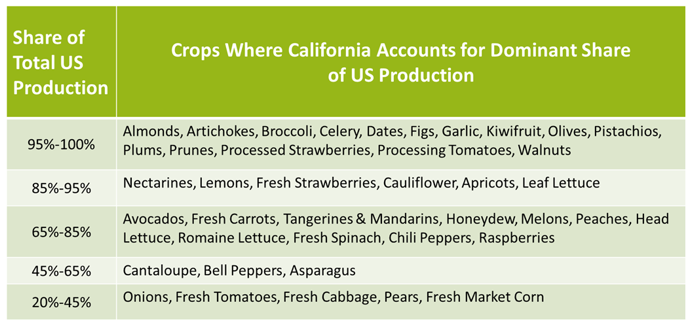
    If you had to guess what percentage of the total US production of broccoli came from California, what would you guess? How about almonds, artichokes, celery, dates, figs, garlic, kiwifruit, olives, processing tomatoes, pistachios, plums, prunes, processing strawberries, or walnuts? 
     
    If you answered between 95-100% for each product, you would be correct; this is not to mention all the other fruit, fiber, and vegetables of which California is the principal producer.

    And yet, due to restrictive water policies, California agriculture is facing an existential threat. Water supply shortages during the 2013-16 drought were exacerbated by policies adopted for the putative protection of fish.  The efficacy of many of those policies are being reevaluated by the United States Department of the Interior, but the State is pursuing new programs that could further reduce water supplies, even during average or wet hydrologic years. The State Water Resources Control Board (SWRCB) is considering mandates that would increase river flows and Delta outflow with its proposed updates to the Water Quality Control Plan. If the SWRCB adopts the proposal made by its staff, even more water will be taken away from farms, businesses, and communities. 

    Indeed, the SWRCB staff estimates water supplies in areas south-of-Delta served by the Central Valley Project will be reduced by as much as 26%.  These reductions will be borne by irrigation water service contractors and will be in addition to water supply reductions caused by actions to implement the 2006 Bay-Delta Plan, the Central Valley Project Improvement Act, and the Endangered Species Act of 1973 (16 U.S.C. 1531 et seq.). 

    It’s time for honesty in the very worthwhile debate about how YOUR water is being prioritized.
    Message From the Westlands Water District
  • Remembering the Creator of the ‘California Raisins’

    The passing last week of noted claymation artist Will Vinton brought back memories of his highly-celebrated work in agriculture: the California Raisins, featuring animated characters that rocketed to fame in the ’80s.

    Vinton himself found fame long before that – winning an Academy Award for co-directing the 1974 short film Closed MondaysHe was the founder of Will Vinton Productions in Portland, Oregon and also created claymation characters for M&Ms.

    The California Raisins were so popular that they were commissioned to appear on lunchboxes and t-shirts and even in Nintendo video games.

    As for California raisins as a crop, they have a farmgate value amounting to hundreds of million dollars annually, ranking them consistently among the state’s top-20 commodities.


  • TULARE COUNTY CROP REPORT – For the week ending September 29, 2018

    SMALL GRAINS, OTHER FIELD CROPS:

    Corn and sorghum continue to be harvested for silage. Alfalfa continues to be cut, dried, and baled for hay. Cotton is in full bloom with bolls set. Black-eyed beans are now being cut and placed in windrows.

    DECIDUOUS TREE FRUITS, NUTS, AND GRAPES:

    The stone-fruit season continues on, yet the season is nearing an end for some packing houses.
    Peaches, nectarines, and plums continue to be exported to Mexico, Australia, Canada, Costa Rica, Honduras, Taiwan, New Caledonia, Guatemala, the Philippines, and China. Apricots continue to be exported to Mexico. Some stone-fruit orchards continue to be removed after harvest to make way for new plantings. Almond harvest continues, with exports to Japan, the Netherlands, Mexico, India, Korea, Australia, Germany, Hong Kong, New Zealand, and Spain. Harvest continues for pistachios, with nuts being exported to Hong Kong, Vietnam, Mexico, and Germany. Table grapes are being shipped domestically and exported to Ecuador, Costa Rica, the Philippines, Australia, New Zealand, Vietnam, Japan, Guatemala, Honduras, Colombia, El Salvador, Mexico, China, Nicaragua, Korea, Taiwan, Indonesia, Hong Kong, and the Netherlands. Plastic tarping is being used on late-variety grapes to protect them from rain. Raisin grapes continue to be picked for sun-drying, with some completing the drying process and being picked up. Quince is being harvested, with exports to Mexico. The harvest of Asian pears continues, with exports to Panama. Persimmons continue to mature and develop external color. Early variety pomegranate harvest continues, with some exports to Australia and New Zealand. Walnuts continue to develop and are nearing maturity in most areas, with some beginning to be harvested.

    CITRUS, AVOCADOS, AND OLIVES:

    Valencia oranges continue to be packed for domestic markets, with some exports to Mexico, China, Hong Kong, and Korea. For many packing houses, the Valencia season has concluded. Finger Lime harvest has begun, with exports to China, France, and the Netherlands. Citrus groves continue to be hedged and skirted. Citrus budding has begun for some varieties. Most olives have reached maturity and are beginning to be harvested.

    VEGETABLES, MELONS, HERBS, AND BERRIES:

    Various summer vegetables continue to be grown and sold at roadside stands and Farmer’s Markets, including assorted peppers, squash, Zucchini, eggplant, and tomatoes. Strawberry beds are being prepared and planted.

    LIVESTOCK AND POULTRY:

    Pasture conditions remain poor. Supplemental feeding with hay and/or grain continues. The Fed Cattle price is at $109 per 100 weight.

    ADDITIONAL COMMENTS:
    Fall shipments of nursery stock from local wholesale nurseries continue. Fall varieties of ornamentals, such as Camellias, are being shipped domestically.

  • Governor Brown Signs Legislation to Strengthen Wildfire Prevention & Recovery

    Governor Edmund G. Brown Jr. today signed legislation to strengthen California’s ability to prevent and recover from catastrophic wildfires, including Senate Bill 901 – authored by Senator Bill Dodd (D-Napa) – which boosts the state’s forest management activities, updates requirements for the maintenance and operation of utility infrastructure to reflect changing climate conditions, and protects ratepayers and utility workers.

    “Wildfires in California aren’t going away, and we have to do everything possible to prevent them. This bill is complex and requires investment – but it’s absolutely necessary,” said Governor Brown.

    “This new law is the most comprehensive wildfire prevention and safety package the state has passed in decades,” said Senator Dodd, who co-chaired the Legislature’s Wildfire Preparedness and Response Conference Committee. “It will help prevent further loss of life and property while ensuring ratepayers aren’t left holding the bag. By enacting this law, we’ve laid a solid base to build on as California continues adapting to the ‘new normal’ caused by climate change.”

    “Senate Bill 901 is the right response to the devastating wildfires that ravaged our state,” said Assemblymember Chris Holden, who co-chaired the Legislature’s Wildfire Preparedness and Response Conference Committee. “The bill provides comprehensive safety solutions to protect ratepayers, makes our electric system safer, and helps stabilize the utilities.”

    Following some of the most deadly and destructive wildfires in state history last year, Governor Brown joined with legislative leaders in March and committed to making California more resilient against future natural disasters in the face of increasingly extreme weather driven by climate change. Some of the significant highlights of SB 901 include:

    • Requiring utilities to implement comprehensive fire prevention plans, including improvements to utility infrastructure.
    • Expediting small landowner incentives and projects to reduce excess fuel and remove dead and dying trees and chaparral.
    • Facilitating access to property to carry out projects to improve overall forest health and resistance to wildfires.
    • Adding a rigorous standard for the California Public Utilities Commission to oversee the allocation of utility wildfire costs and expenses, including consideration of climate change impacts.
    • Authorizing a financing mechanism so utilities can spread out wildfire costs to minimize impacts to ratepayers.
    • Adding worker protections and prohibiting utilities from charging their customers for executive compensation.

    “The Senate worked diligently this year to find commonsense solutions to wildfires that have now become a regular feature of life in California. Every Senate district is touched by the consequences of a warming climate and the wildfires that come with it,” said Senate President pro Tempore Toni G. Atkins. “Of particular significance is SB 901 which prevents future catastrophic wildfires across the state while protecting utility ratepayers from unfairly bearing the costs of wildfire impacts. I thank my colleagues in the Senate and the Assembly for the diligence in tackling this issue. And I thank Governor Brown for his engagement throughout the process.”

    “The forestry management funding in SB 901 makes broad changes that will encourage local communities to better plan for wildfires and ease landowners’ efforts to conduct fuel treatments on their land. The $1 billion provided for that effort will go a long way,” said Assembly Speaker Anthony Rendon.

    “This year alone, 1.3 million acres of California have burned. The loss of life and property has been staggering. We are taking steps to ensure that this doesn’t happen again. SB 901 is a necessary first step,” said Assembly Republican Leader Brian Dahle.

    “Catastrophic wildfires have disrupted the lives of hundreds of thousands of Californians due to decades of neglect and failure to manage our forests and wildlands. This legislation is an important step toward safeguarding lives, property and the state’s watersheds,” said Senator Jim Nielsen.

    The 2018 wildfires are already approaching last year’s total acreage burned – 1.4 million – with several months left in the calendar year. Four of California’s five most destructive wildfires on record have burned in the last 15 years.

    In addition to working with lawmakers on a solution, Governor Brown in May issued an executive order to improve the health of the state’s forests and help mitigate the threat and impacts of deadly and destructive wildfires, which hinder the state’s progress toward its climate goals. Forests serve as the state’s largest land-based carbon sink, drawing carbon from the atmosphere and storing it in trees and shrubs and in forest soils. But even a single wildfire can immediately cancel all those benefits.

    In addition to SB 901, the Governor also signed the following bills today:

    SB 30 by Senator Ricardo Lara (D-Bell Gardens) requires the Insurance Commissioner to convene a working group to assess new and innovative investments in natural infrastructure and insurance products in light of California’s worsening fire vulnerability due to climate change.

    SB 821 by Senator Hannah-Beth Jackson (D-Santa Barbara) authorizes counties to enter into an agreement to access the contact information of public utility customers for the sole purpose of enrolling county residents in a county-operated public emergency warning system.

    SB 824 by Senator Ricardo Lara (D-Bell Gardens) prohibits an insurer from canceling or refusing to renew a homeowner’s insurance policy for one year from the date of a declaration of emergency and requires insurers to report specified fire risk information to the Department of Insurance.

    SB 833 by Senator Mike McGuire (D-Healdsburg) requires the Office of Emergency Services, in consultation with specified stakeholders, to develop voluntary guidelines for alerting and warning the public of an emergency.

    SB 894 by Senator Bill Dodd (D-Napa) provides assistance to survivors of major disasters or catastrophic events, including requiring insurers to renew a residential insurance policy for at least two renewal periods (24 months), requiring insurers to grant an additional 12 months of additional living expenses and allowing combined payments for losses to a primary dwelling and other structures so homeowners can apply those losses as they see fit, such as rebuilding the main home.

    SB 896 by Senator Mike McGuire (D-Healdsburg) extends the sunset date on the state’s aggravated arson statute to help ensure law enforcement agencies maintain a valuable deterrent to prevent arson-caused wildfires.

    SB 917 by Senator Hannah-Beth Jackson (D-Santa Barbara) requires insurers to cover a loss resulting from a combination of disasters (landslide, mudslide, mudflow or debris flow) if an insured disaster is the proximate cause of the loss or damage and would otherwise be covered.

    SB 969 by Senator Bill Dodd (D-Napa) requires residential automatic garage door openers manufactured for sale, sold, or installed in California to have a backup battery that is designed to operate during an electrical outage and prohibits replacement garage doors from being installed without backup batteries.

    SB 1079 by Senator Bill Monning (D-Carmel) authorizes the California Department of Forestry and Fire Protection to make advance payments to grantees receiving funds from the healthy forest and local fire prevention grant programs.

    SB 1181 by Senator Ben Hueso (D-San Diego) authorizes the Office of Emergency Services to enter into an agreement with one or more certified community conservation corps to perform emergency or disaster response services.

    SB 1260 by Senator Hannah-Beth Jackson (D-Santa Barbara) authorizes federal, state and local agencies to engage in collaborative forestry management, creates new opportunities for private landowners to partner with public agencies to mitigate wildfire risk and enhances the Department of Forestry and Fire Protection’s role in identifying wildfire hazards as local governments plan for new housing and neighborhoods.

    SB 1261 by Senator Jim Nielsen (R-Gerber) ensures that one-time death benefits are provided to eligible survivors of pilots fighting an active California fire even if they fly their own aircraft or one owned by an entity other than the state.

    AB 1772 by Assemblymember Cecilia Aguiar-Curry (D-Winters) extends from 24 months to 36 months the period of time within which an insurance policyholder is entitled to collect full replacement benefits under a replacement cost fire insurance policy.

    AB 1800 by Assemblymember Marc Levine (D-Marin County) prohibits, in the event of a total loss, a residential property insurance policy from limiting or denying payment based on the fact that the policyholder has chosen to rebuild or purchase a home at a new location.

    AB 1875 by Assemblymember Jim Wood (D-Healdsburg) connects consumers who need residential property insurance with agents and brokers to help ensure they obtain plans and coverage that suit their specific needs.

    AB 1877 by Assemblymember Monique Limón (D-Goleta) requires the Office of Emergency Services to create a library of translated emergency notifications and translation style guide and requires authorities to consider using the library and translation style guide when issuing emergency notifications to the public.

    AB 1919 by Assemblymember Jim Wood (D-Healdsburg) expands the scope of criminal price gouging by including rental housing that was not on the market at the time of the proclamation or declaration of emergency and defines the rental price of housing for purposes of price gouging.

    AB 1956 by Assemblymember Monique Limón (D-Goleta) establishes a grant program to support fire prevention activities, including vegetation management, grazing, prescribed burns, creation of defensible space and retrofitting structures to increase fire resistance.

    AB 1981 by Assemblymember Monique Limón (D-Goleta) requires the Department of Forestry and Fire Protection and the Forest Management Task Force to coordinate with the California Environmental Protection Agency to promote the use of forestry material in compost.

    AB 2091 by Assemblymember Tim Grayson (D-Concord) requires the Forest Management Task Force, in coordination with the California Department of Insurance, to develop recommendations to reduce the cost of conducting prescribed burns.

    AB 2126 by Assemblymember Susan Eggman (D-Stockton) requires the California Conservation Corps director to establish a Forestry Corps Program by July 1, 2019. The program would provide corps members with job training and placement in forest health projects.

    AB 2380 by Assemblymember Cecilia Aguiar-Curry (D-Winters) requires the state to develop standards and regulations for privately contracted fire prevention operations that are conducted during an active fire incident.

    AB 2518 by Assemblymember Cecilia Aguiar-Curry (D-Winters) requires the Department of Forestry and Fire Protection to explore markets for innovative forest products and mass timber consistent with the state’s climate objectives.

    AB 2551 by Assemblymember Jim Wood (D-Healdsburg) allows the director of the Department of Forestry and Fire Protection to enter into agreements with landowners to conduct joint prescribed burning operations.

    AB 2594 by Assemblymember Laura Friedman (D-Glendale) extends the existing statute of limitations for a homeowner to sue an insurer from 12 to 24 months if the loss is related to a state of emergency.

    AB 2889 by Assemblymember Anna Caballero (D-Salinas) requires the Department of Forestry and Fire Protection to provide assistance and develop guidance documents to reduce timelines for timber harvest plan review and approval.

    AB 2911 by Assemblymember Laura Friedman (D-Glendale) makes various changes to fire safety planning efforts, defensible space requirements and vegetation clearance requirements for electrical transmission and distribution lines to improve the fire safety of California communities.

    AB 2990 by Assemblymember Evan Low (D-Campbell) provides surviving dependents of a deceased firefighter or law enforcement officer free tuition and fees within the California Community College, State University and University of California systems.

    For full text of the bills, visit: http://leginfo.legislature.ca.gov

  • US Trade Mitigation Package Direct Payments for Almonds

    The Almond Alliance of California appreciates the efforts by the U.S. Department of Agriculture to establish the procedures required to provide direct payments to almond growers to help offset some of the damage being incurred due to the retaliatory tariffs imposed by China and Turkey. As announced today by Secretary of Agriculture Sonny Perdue, growers of California almonds are now eligible to apply for direct payments of $.03 per pound as part of the $12 billion mitigation package announced earlier this month. The damage assessment figure assigned to almonds is $63.3 million.
    The announcement is a result of the industry coming together and advocating through the Almond Alliance of California (AAC). Elaine Trevino, President/CEO of AAC said “Industry members should be proud that through a unified effort they were able to have their voices heard and be acknowledged for their contribution to the national economy, along with the significant role they play in the international market place.”
    The almond industry has been significantly impacted by retaliatory tariffs and the inclusion of the commodity in the USDA trade mitigation package is a result of a vocal industry and the support and hard work of California’s congressional delegation. Trevino noted, “The direct payment program reflects the hard work of Majority Leader Kevin McCarthy and Chairman Jeff Denham who led the congressional effort including Congressmen Costa, Valadao, Nunes, LaMalfa, Pannetta and Senators Harris and Feinstein. Their combined efforts and leadership helped ensure that the California almond industry received direct payments within the specific program guidelines. We are thankful that our congressional delegation worked hard for our industry and acknowledged the importance of almonds to the California and U.S. economy.”
    Producers of almonds can sign up for the Market Facilitation Program (MFP), which is a direct payment program for eligible almond growers who have been directly impacted by retaliatory tariffs, resulting in significant export losses. The MFP is established under the statutory authority of the Commodity Credit Corporation (CCC) Charter Act and is under the administration of the U.S. Department of Agriculture (USDA) Farm Service Agency (FSA). There are specific eligibility requirements that must be met by an applicant and the maximum payment per applicant is $125,000. Eligible almond growers may apply for MFP September 24, 2018 through January 15, 2019.
    Almonds are one of California’s top three valued commodities and the leading agricultural export.  The California almond industry exports 67% of what it produces.  With exports of nearly $4.5 billion in 2017, the California almond industry contributes significantly to the longstanding trade surplus generated by American agriculture. While the mitigation initiatives are helpful, they will not begin to approach the anticipated economic losses and long-term impact these retaliatory tariffs will have on the industry’s trade relationships and the considerable investments made over the years to create market demand in China and Turkey. Trevino pointed out, “We remain hopeful for a quick resolution to the broader trade disputes with these trading partners to ensure open and fair trade so consumers around the globe can continue to enjoy California almonds.”
    For more Information:
    For more information about the MFP program, visit www.farmers.gov/MFP or contact your local FSA office. To find your local FSA office, visit www.farmers.gov.
    ​​​​​​​
    About the Almond Alliance of California
    The Almond Alliance of California (AAC) is a trusted non-profit organization with a mission of advocating on behalf of the Almond industry in California. AAC actively advocates for the positions of almond growers, hullers, shellers, handers and processors, while educating the industry about upcoming and existing regulatory changes.  Through workshops, newsletters, conferences and meetings, AAC serves as a clearing house of information that informs the almond industry and continues to position the industry as an agricultural leader in the state.