Category: Non-Video

  • Wine Industry Leader Nat Dibuduo to be Honored

    Fresno, Calif., (March 28, 2018) – Nat DiBuduo will be honored at the Outlook 2018 Agribusiness Conference in Visalia tomorrow, March 22, at the Visalia Convention Center, as the Distinguished California Agriculturalist of the Year. The award, recognizing an individual who has contributed in a significant and highly visible way to the betterment of California agriculture, is presented by the California Chapter of the American Society of Farm Managers and Rural Appraisers (ASFMRA) annually.

    Nat DiBuduo

    DiBuduo is currently President and CEO of Allied Grape Growers, a marketing association with over 500 members who produce over 250,000 tons annually. Nat has been involved in agriculture all of his life, having worked with his family (Papagni Fruit Company) farming and developing vineyards in Fresno, Madera and Kern Counties through college. Nat and brother, Jerry, formed DiBuduo Farm Management (DLM) in 1978 where Nat stayed until 1984 at which time Jerry expanded and incorporated the company while Nat went on to work as Vice President of Pro Ag, a pioneering fully integrated pest management company. Ownership of DiBuduo Ag Services, an agricultural consulting firm, and employment with Capital Agricultural Property Services, Inc. managing agricultural land throughout California and Arizona, were all part of Nat’s career journey prior to joining Allied Grape Growers in 2000.

    Nat has received numerous recognitions for his work and leadership in agriculture including being named one of the Top 50 Leaders in the California Wine Industry by Wine Business Monthly in both 2016 and 2017, receiving the ‘2014 Profiles in Leadership Award’ by the Agriculture Leadership Foundation, and being recognized by the California Association of Winegrape Growers as CAWG Leader of the Year in 2012, to name a few.

    Nat’s career has always gone hand in hand with his support of the agriculture industry, his community, and his Alma Mater, California State University Fresno, further demonstrating his commitment and dedication to improving and promoting California Agriculture. He was appointed to the CSU Fresno Foundation Board of Governors, was past chair of the CDFA DP/GWSS Board, is a member of Friends of Fresno Fair, and served on the City of Fresno Mayor’s Advisory Committee. Nat is also a graduate of the California Agriculture Leadership Program Class VI and earned the Accredited Farm Manager (AFM) designation with the nationally recognized American Society of Farm Managers and Rural Appraisers.

    Questions may be directed to the California Chapter, ASFMRA Office at 209-368-3672 or info@calasfmra.com.

    Source: California Chapter ASFMRA, News Release, March 15, 2018

  • SCFB – 104th Annual Meeting of Members April 19!

    Turlock, Calif., (March 26, 2018) – Stanislaus County Farm Bureau (SCFB) will host its 104th Annual Meeting of Members “Tell Your Story” on April 19. This event serves as our organizations biggest annual fundraiser for programs such as Ag in the Classroom, Stanislaus Safety Seminar, Young Farmers & Ranchers, purchasing livestock animals at the Stanislaus County Fair and college agriculture scholarships. Without the support of our sponsors and guests we could not make these valuable programs a success.

    This year we are excited to welcome our guest speaker, former San Francisco Giants pitcher, cancer survivor and motivational speaker, Dave Dravecky. Dravecky, a Turlock resident, will share his inspirational story of triumph after tragedy.

    The support for this event from our agriculture industry partners over the years has been tremendous and much appreciated! Once again, we have a number of sponsorship and tradeshow booth opportunities available to fit your company or organizations needs. We will also hold a silent auction at the event and are gladly accepting any auction donations.


  • CDFA Announces Vacancy on the Nursery Advisory Board

    Sacramento, Calif., (March 26, 2018) – The California Department of Food and Agriculture’s (CDFA) Pest Exclusion Branch is announcing one mid-term vacancy on the Nursery Advisory Board.  The Board is composed of twelve voting members, each representing an establishment with a valid California License to Sell Nursery Stock.  No two members shall represent the same organization.  Members will represent a wide spectrum of the nursery industry, and the Board will be geographically representative of the nursery industry in California.

    The term of office for Board Members is four years. This position is a mid-term appointment and the term ends on January 31, 2021. Members typically meet twice per year but can meet more frequently if needed.  The members receive no compensation but are entitled to payment of necessary traveling expenses in accordance with the rules of the California Department of Human Resources.

    In addition, the Board includes eight non-voting ex officio members from the County Agricultural Commissioner and Sealers Association, the University of California, and groups affiliated with the nursery industry.

    The mission of the Nursery Advisory Board is to grow and maintain a strong relationship between CDFA and the nursery industry in order to secure the industry’s future.  The Board facilitates communication between state and federal regulators and the nursery industry, and it advises CDFA’s Nursery Services Program on policies, fees, and other issues concerning nurseries and nursery stock.

    Individuals interested in being considered for this Board appointment should send a brief résumé to Erin Lovig, Board Manager, by April 30, 2018 at:

    California Department of Food and Agriculture
    Pest Exclusion Branch
    1220 N Street, Room 344
    Sacramento, CA 95814
    Attention: Erin Lovig

    For additional information, you may contact the Nursery Services Program at (916) 654-0435.

  • New Report Details How Cap-and-Trade Proceeds Benefit California

    Sacramento, Calif., (March 26, 2018) – A new report details the dramatic growth last year in Cap-and-Trade investments that are reducing greenhouse gas emissions while strengthening local economies and improving public health and the environment across the state, especially in disadvantaged and low-income communities.

    More than $720 million in new funding last year went to projects that were either under way or completed across all of California’s 58 counties, a two-thirds increase in implemented investments. From rebates for electric cars to affordable housing units, completed projects totaled 75,000, including doubling the number of home energy efficiency installations and nearly tripling the number of trees planted.

    The report tracking the progress of California Climate Investments was released today by the California Air Resources Board (CARB) and the California Department of Finance.

    Signed by Governor Edmund G. Brown Jr. in July, Assembly Bill 398 extended and improved the state’s world-leading Cap-and-Trade program to ensure California continues to meet its ambitious climate change goals and that billions of dollars in auction proceeds keep flowing to communities across the state through California Climate Investments.

    “The investment of Cap-and-Trade proceeds is an important part of the state’s overall climate efforts, reducing climate-changing gases and improving quality of life especially in the state’s most vulnerable communities,” said CARB Chair Mary D. Nichols. “California communities across the state are reaping the fruit of these investments in better air and improved transit. Governments around the world are looking to California as a model for how protecting the environment can strengthen their economies”

    Since 2014, $6.1 billion has been appropriated to 17 state agencies that have distributed $2 billion to projects that are completed or under way. Agencies have awarded more than 80 percent of funds appropriated before September 2017. Additionally, implemented funds (not including the High-Speed Rail Project) have attracted over $8.2 billion from other sources representing an average of nearly $6 leveraged for every dollar invested.

    Among the projects:

    • A 44-unit affordable housing development in Tulare County with integrated vanpooling service and discount transit passes is among more than 1,600 housing units funded statewide.
    • The Cecchini Farm in Contra Costa County, whose fifth-generation owners decided not to sell after they were approved for a conservation easement, is among more than 250,000 acres of land statewide that will be preserved, from coastal watersheds and wetlands to mountain meadows.
    • Los Angeles County’s Foothill Transit is purchasing 15 zero-emission electric buses to advance the agency’s goal to go all-electric by 2030 to reduce GHG emissions and improve air quality in the inland communities it serves.

    In California’s forests, California Climate Investments are protecting more than 1.4 million acres, funding projects to reduce fire risk, limit loss of life and property damage, and lower the cost of fighting wildfires. More than 14,000 trees have been planted to provide shade and limit the heat island effect in urban areas from Oakland and Stockton to San Bernardino and Los Angeles counties.

    Grants to farmers, businesses and individuals for more water-efficient technology will not only cut greenhouse gas (GHG) emissions but save more than 370 billion gallons of water throughout the state. And more than 150,000 rebates for zero-emission and plug-in hybrid cars are expected to reduce over 5,000 tons of criteria and toxic air pollutants in addition to GHG emissions.

    The report features profiles that highlight the impact these investments are having on individuals and communities, particularly those in California’s most disadvantaged communities.

    Benefits to Disadvantaged Communities

    Fifty-one percent of the $2 billion in implemented projects ($1 billion) is providing benefits to disadvantaged communities, including 31 percent ($615 million) going to projects located within these communities. This exceeds the requirement under SB 535 (De León) that at least 25 percent of investments are allocated to projects that benefit disadvantaged communities.

    The report also found that projects are underway in 98 percent of the 2,000 census tracts in the state that the California Environmental Protection Agency designated as disadvantaged. And state agencies are actively working to make investment opportunities more accessible to disadvantaged communities through technical assistance grants and increased outreach.

    In 2016, Governor Brown signed AB 1550 establishing new investment minimums for disadvantaged communities, and low-income communities and households. The Legislature directed the 2019 Investment Plan to allocate funding in accordance with AB 1550. In 2017, CARB released guidance to help administering agencies to begin implementing AB 1550.  Future reports will include AB 1550 outcomes as agencies implement more funding.

    Reducing Greenhouse Gas Emissions

    Projects funded to date are expected to reduce GHG emissions by more than 23 million metric tons of carbon dioxide equivalent (CO2e), roughly the equivalent of taking four million cars off the road for a year. In addition, the High Speed Rail Project is estimated to reduce GHG emissions by almost 59 million metric tons of CO2e over its operating life.

    The report includes detailed information on cost-effectiveness and metrics for evaluating program effectiveness. It also includes new statistics and information on co-benefits quantified to date and an update on plans for more comprehensive future reporting.

    Accompanying the report is an updated interactive map that allows users to track where Cap-and-Trade funds are being invested across in the state. Users can view the locations of individual projects and aggregate them by program and by the state’s 120 legislative districts and 58 counties.

    Note – CDFA receives Cap-and-Trade investments for four programs in its Office of Environmental Farming and Innovation. They are the Dairy Digester Research and Development Program, the State Water Efficiency Enhancement Program (SWEEP), the Healthy Soils Program, and the Alternative Manure Management Program.

    Project-level data for all projects included in the 2018 Annual Report and featured on the interactive map is available on the California Climate Investments website, including project locations, GHG reductions and benefits to disadvantaged communities.

    The 2018 Annual Report to the Legislature on California Climate Investments Using Cap-and-Trade Auction Proceeds can be found here.

    California Climate Investments Website

    2018 California Climate Investments Annual Report

    Interactive Map of California Climate Investments Statewide

    2018 Project Profiles

  • TechAccel Makes Further Pledge to the UC Davis Venture Catalyst STAIR Grant Program to Promote Agriculture

    Davis, Calif., (March 23, 2018) – UC Davis Venture Catalyst and TechAccel LLC, a Kansas City-based technology and venture development company, today announced an expanded partnership that provides increased support for the university’s Science Translation and Innovative Research (STAIR™) Grant program, which provides funding for proof-of-concept research aimed at demonstrating commercial feasibility of university-generated technologies.

    TechAccel will commit $50,000 in grant funding to an expansion of the Venture Catalyst STAIR grants, which are in their fifth year of enabling the commercial translation of UC Davis research and technologies through proof-of-concept funding.

    This promise of additional funding is intended to elicit more agricultural-focused technologies. TechAccel’s additional funding will support a sixth STAIR grant this year focusing exclusively on a technology in plant or animal agriculture, animal health, animal nutrition, or technologies to reduce postharvest food waste and increase food safety. If successful, this expanded program may be repeated.

    “We are proud to collaborate with the world-class talent at UC Davis,” said Michael Helmstetter, president and CEO of TechAccel. “Together, we see opportunities to make a greener, healthier future by helping advance agriculture, animal health and food safety technologies to market.”

    Dushyant Pathak, associate vice chancellor for research and executive director of Venture Catalyst at UC Davis, agreed.

    “We’re thrilled with this generous enhancement to our existing collaboration with TechAccel which has already provided support for novel translational research at the university,” he said. “TechAccel’s unique focus and its combination of business and technical expertise provide the perfect complement to our strengths at UC Davis in technology development and product innovation for societal impact.”

    TechAccel is a technology and venture development organization focused in agriculture, animal health and food technology. The company invests in innovative technology and funds science advancement programs to accelerate readiness for commercialization.

    TechAccel began its collaboration with the university in 2016 with participation in the UC Davis Venture Catalyst STAIR-Plus™ program, which supports STAIR grant recipients who successfully achieve their commercialization milestones.

    As part of the program, TechAccel executives participate in the review and assessment of grant applications in agriculture, animal health, food and nutrition. TechAccel executives provide mentorship to grant-winning researchers, who may also be considered for future TechAccel emerging company investments.

    TechAccel also recently announced an investment in a science advancement project underway at the Siegel Lab in the Genome Center at UC Davis. This project, led by Justin B. Siegel, assistant professor of chemistry biochemistry and molecular medicine as well as faculty director of the Innovation Institute for Food and Health at UC Davis, is directed toward identifying mutations in a wheat enzyme to produce plants capable of thriving in warmer temperatures.

  • Thousands in the San Joaquin Valley Have Unsafe Drinking Water, But Clean Water Is Close

    Davis, Calif., (March 23, 2018) – Tens of thousands of people living in the San Joaquin Valley’s unincorporated, rural, low-income communities have unsafe drinking water pouring from their taps. That water is delivered from a patchwork of community water systems that often don’t meet state or federal standards for drinking water, or from private wells that are not tested.

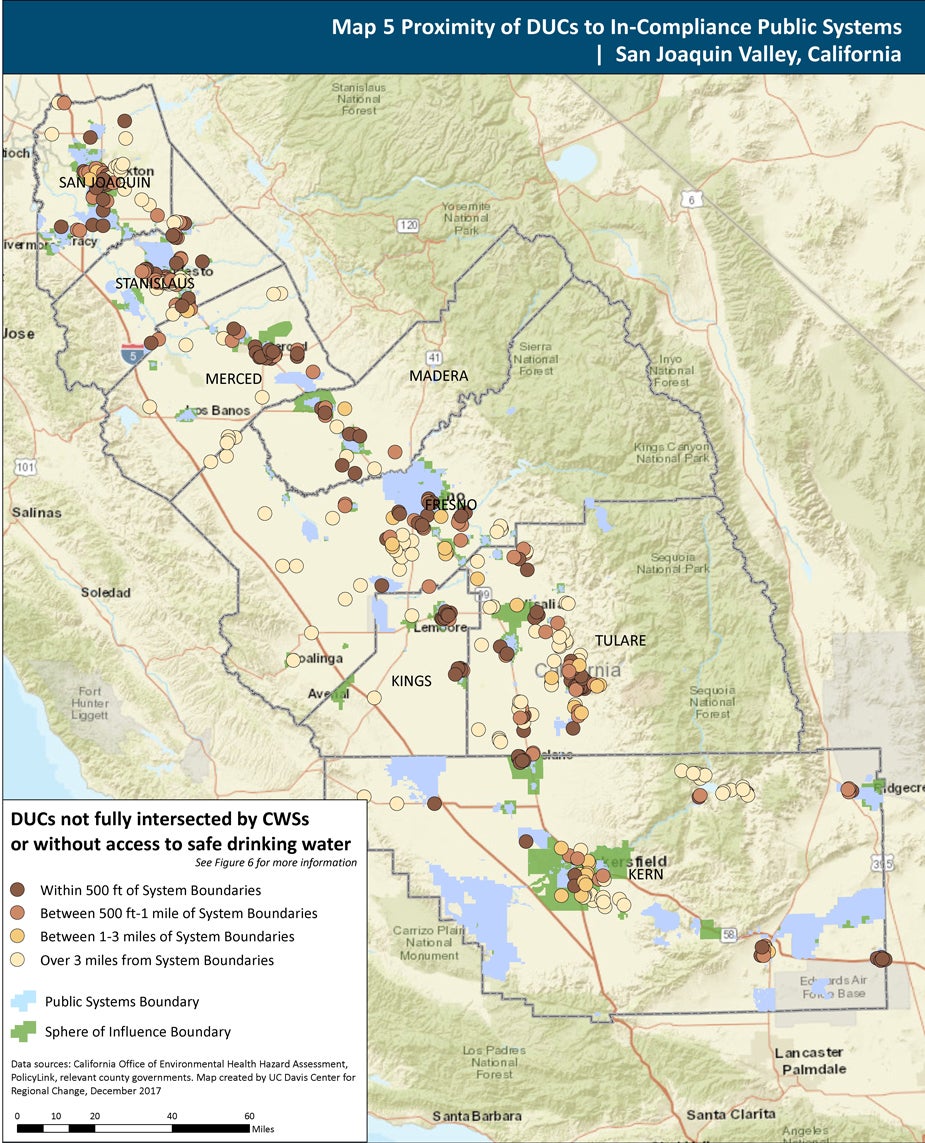
    However, a University of California, Davis, study that assessed water systems throughout the valley found that safe water is often close at hand. Most people without safe water, or about 99,000 residents, live near public systems with clean water. They could access that water if service extensions, piping and other infrastructure were implemented, the report found.

    Each Dot represents a community without safe drinking water, and the dot’s color indicates the distance from a source of safe water. Click on this link to view the whole map: https://www.ucdavis.edu/sites/default/files/news/campus-news/2018/mar/map-karen-925.jpg

    “There are solutions,” said Jonathan London, associate professor, director of the

    Click here to see the full map. Each dot represents a community without safe drinking water, and the dot’s color indicates the distance from a source of safe water.

    Some of that work is already happening. Students in the UC Davis School of Law Aoki Water Justice Clinic have been meeting with these communities to secure funding to build that infrastructure. Law students are also working with community organizations seeking policy changes to increase access to safe drinking water for low-income Californians.

    “We are confident that these communities, local water systems, and the state can work together to fund and encourage infrastructure improvement to ensure that no one in the San Joaquin Valley need worry about what is coming out of their faucets,” London said.

    The report, “The Struggle for Water Justice in the San Joaquin Valley: A Focus on Disadvantaged Unincorporated Communities,”looked at access to safe drinking water in low-income communities without city governments in the eight counties of the San Joaquin Valley.

    The study’s purpose is to inform state policy and local planning in order to improve access to safe drinking water for these communities.


    “Within the next decade and with adequate funding, we could solve a problem that has plagued low-income, rural communities for over 50 years,” said Camille Pannu, the water justice clinic director who also contributed to the report.

    Success stories are found already in Tulare and Kings counties – The report found that more communities need to follow the examples from Kings and Tulare counties, where residents with unsafe water recently consolidated some water delivery systems and added lines to provide safe drinking water to residents. Previously, the people in the affected communities had dangerous levels of arsenic and nitrates in their water supplies.

    Using a combination of solutions, the communities forged agreements among existing water agencies and obtained grants to help finance the changes, and in some cases, the state ordered consolidations.

    The poor and people of color are adversely affected – People of color made up a majority of those without safe water, the Center for Regional Change study found. For example, while Hispanics make up just under half, or 49 percent, of the total population of the San Joaquin Valley, they represent more than two-thirds of residents in these unincorporated communities and 57 percent of all residents served by out-of-compliance water systems. Caucasians account for about 36 percent of those receiving water from unsafe systems.

    Those without safe water face additional economic burdens as they need to augment their water needs by buying bottled water, or purchasing filter systems, for drinking and cooking.

    Study proposes practical solutions:

    Ways safe drinking water can be achieved, according to the report, include:

    • Develop and strengthen consolidation and service extension mandates and incentives for cities, counties and community water systems.
    • Create larger, more stable, and more equitably distributed and coordinated sources of funding for drinking water systems.
    • Improve public access to data and planning tools; enhance existing data systems and coordinate water monitoring efforts.

    The research began in fall 2016, and was funded by Resources Legacy Fund and the Water Foundation.

    School of Law Water Justice Clinic – The Aoki Water Justice Clinic combines transactional law, policy advocacy and strategic research to ensure low-income California communities receive clean, safe and affordable drinking water. Established in 2017, it is believed to be the first law school clinic of its kind in the country.

    • Law students in the clinic have worked in 13 low-income, rural communities in Fresno, Kern, Lake, Mono, Sonoma, Tulare and Tuolumne counties.
    • Through their work, students have extended (or are in the process of extending) access to safe drinking water to 15,800 Californians.
    • Four students are providing on-the-ground community organizations with policy research and analysis for state legislation introduced this year.
    • Students are leading or supporting research collaborations, including partnerships with the UC Davis Center for Regional Change, UC Cooperative Extension and the UC Berkeley School of Law’s Wheeler Water Institute.
  • Tulare County Reports on Current Crop Status

    Visalia, Calif., (March 23, 2018) – Tulare County Agricultural Commissioner released the current status today of Major crops in the most valued county in the California Ag portfolio. They report that Corn is being planted as weather allows. Winter wheat and oats are enjoying the latest rains, growth is excellent. Ground preparation is continuing for spring row crops. Alfalfa fields need more time and dry weather to fully develop before harvest begins. Overall this week’s rainfall was beneficial to field crops.

    Vineyards continue to be pruned and tied. Stone fruit orchards are continuing to bloom and leaf out. Almond trees are blooming and leafing out. Bee colonies continue being moved into almond and stone fruit orchards to help with pollination. Orchards are being monitored for possible damage from the recent freeze to the bloom, but the extent (if any) is as yet unknown. Pomegranate and walnut orchards continue to be pruned. Pistachios are being exported to Germany, Hong Kong, Italy, and Spain. Almonds are being shipped to Barbados, Colombia, Germany, Hong Kong, Israel, Japan, Korea, the Netherlands, Taiwan, Trinidad & Tobago, and the United Kingdom.

    Navel oranges, Mandarins, and lemons continue to be harvested, but at a slower rate. The harvest of late variety navel oranges continues, and fruit are showing some grading issues. The extent of freeze damage to citrus fruit is still being determined. Some pruning and skirting of orange groves is still occurring. Navel oranges are being exported to Australia, China, Hong Kong, Korea, Mexico, New Zealand, and Taiwan. Mandarins are being picked and shipped to Indonesia, Japan, Korea, and New Zealand. Seedless tangerine groves continue to be netted in preparation for the coming bloom. Lemons are being exported to Hong Kong, Japan, and Korea. Minneola tangelos continue to be shipped to Germany, Japan, and the Netherlands. Some citrus trees are being planted. Olive groves continue to be pruned.

    Squash and cucumber seedlings continue to grow under hot-caps and hot-tunnels. Greenhouse vegetables continue to be harvested. Strawberry and plantings are progressing well and maturing. Blueberries should begin to bloom late in the week.

    This week’s rain was beneficial, and should improve the rangeland forage condition, As always, more rain is needed. The fed cattle market dropped $3.00 to $127.00 per hundred weight this week.

    Retail nurseries are stocked up on both perennial and annual plants for the spring season. Bare-root roses are being received and processed for reshipment to various U.S. states, Canada, France, Japan, and Korea. Some mature olive trees are being dug for landscape purposes.

  • Roof Rats Unnerve Farm Workers, Damage Orchard Crops

    Davis, Calif., (March 22, 2018) – Monitor for rodent activity and use bait stations before the growing season to prevent problems, UC ANR scientists recommend.

    Roof rats are running rampant in California orchards this year, according to UC Agriculture and Natural Resources scientists.

    “In pistachio and other nut orchards, roof rats are burrowing and nesting in the ground where they’re chewing on irrigation lines, causing extensive damage,” said Rachael Long, UC Cooperative Extension advisor. “They are also nesting in citrus trees, feeding on the fruit and terrifying field workers when they jump out as people are picking fruit. The chewing pests are also girdling citrus limbs, causing branch dieback.”

    The wet winter of 2017 led to lots of weed seeds for rats to eat. “Last season, rats were also nibbling on pomegranates, avocados, and other fruit and nut crops, rendering them unmarketable,” Long said.

    Holes in the ground around the base of pistachio trees throughout a Yolo County orchard puzzled the grower.

    “We looked for ground squirrels, but never saw any,” Long said. “We set up game cameras, but only got birds and rabbits. We put rodent bait in the holes, but the digging didn’t stop.”

    Long, the pest detective, cracked the case by consulting Niamh Quinn, UC Cooperative Extension human-wildlife interactions advisor based in Irvine. “She informed us that the damage we were seeing was from roof rats.”

    Burrowing roof rats sounds like an oxymoron. While roof rats generally don’t burrow in urban environments, their country cousins have been known to burrow.

    “It’s not true that they don’t burrow,” Quinn said. “When I worked as staff research associate for Roger Baldwin, UC Cooperative Extension wildlife specialist, that is mostly what we studied, burrowing roof rats in orchards.”

    Roof rats are nocturnal animals that climb trees and burrow underground.

    Control measures – Baldwin said, “It seems to be a good year for rats in a number of different areas and crops throughout the state. I’ve received more questions and comments about rats this year than perhaps the last 10 years combined. As for bait application, putting bait down burrow systems for rats doesn’t usually work too well, so I’m not surprised that approach didn’t work. Growers will likely have better luck with bait stations in the trees.”

    Because the rats climb, Baldwin suggests attaching bait stations to tree branches.

    “In addition, elevating the bait stations will eliminate access to bait for many protected mammal species, such as kangaroo rats,” Long said. “The bait diphacinone grain can be purchased from some ag commissioners’ offices. This is what Roger Baldwin said they tested and it worked.”

    As for the bait stations, they should be designed so that there isn’t any spillage for nontarget animals to eat, Long said.

    When roof rat outbreaks occur, rodenticides are often needed to prevent crop damage. However, timing is critical as diphacinone use is highly restrictive and not allowed during the growing season, which is beginning as the weather warms.

    “Check the product label for application instructions,” Long reminds growers. “It’s the law.”

    Because roof rats climb, UC Cooperative Extension wildlife specialist Rager Baldwin recommends attaching bait stations to tree branches.

    Identifying the pest – One way for growers to identify whether they have roof rats is by the size of the burrows. The nocturnal pests are active above ground in trees and below ground.

    “Roof rats can forage away from their nest, so you won’t likely find signs of their activity, such as rat droppings outside their burrow, to help identify them,” Long said.

    Ground squirrels are active during the day, so they are more likely to be seen, dig holes about 4 inches in diameter and forage above ground near their burrows. Vole and mouse holes are 1- to 2-inches in diameter. Roof rat holes are typically 3 to 4 inches in diameter and might have nut shells in front of them, for example pistachio or almond shells. Rabbits will feed on seedling crops, but do not dig burrows.

    Roof rats are prolific breeders that reproduce year-round, according to Baldwin. Females typically have three to five litters per year with five to eight young, enabling their populations to rapidly increase. The omnivores feed on a wide variety of plant and animal materials, allowing them to adapt to any environment, including urban and agricultural lands.


    “Rats are sneaky and hard to spot,” Long said. “If you see damage, including digging in the soil but no wildlife, suspect rats.”

    For more information on controlling roof rats, download Quinn and Baldwin’s free UC ANR publication 8513, Managing Roof Rats and Deer Mice in Nut and Fruit Orchards at http://anrcatalog.ucanr.edu/Details.aspx?itemNo=8513.

    For more information about ground squirrels, download the free UC IPM Best Management Guidelines http://www.groundsquirrelbmp.com or UC IPM Pest Note http://ipm.ucanr.edu/PMG/PESTNOTES/pn7438.html.

    Roof Rats are causing damage in nut and tree fruit orchards.
    Roof rat holes are typically 3 to 4 inches in diameter.
    Ground squirrels are active during the day and their burrows are 4 inches or more in diameter.
  • UCCE Advisor Rachel Surls Receives 2018 Bradford Rominger Agricultural Sustainability Leadership Award

    Davis, Calif., (March 22, 2018) – The Agricultural Sustainability Institute at UC Davis has announced that Rachel Surls, UC Cooperative Extension sustainable food systems advisor for Los Angeles County, is this year’s recipient of the Eric Bradford and Charlie Rominger Agricultural Sustainability Leadership Award.

    Rachel Surls

    Surls has been committed to community gardens, school gardens, and urban agriculture since long before our cities took notice. For 30 years, she has worked at the UC Cooperative Extension Office in Los Angeles County, helping to bring city-grown food into the mainstream.

    The Bradford Rominger award, given yearly, honors individuals who exhibit the leadership, work ethic and integrity epitomized by the late Eric Bradford, a livestock geneticist who gave 50 years of service to UC Davis, and the late Charlie Rominger, a fifth-generation Yolo County farmer and land preservationist.

    “In her three decade career with UCCE, Rachel has developed a strong program addressing some of our most critical issues in sustainable agriculture,” says Keith Nathaniel, the Los Angeles County Cooperative Extension director. “She does so with innovative strategies, working with all aspects of the LA community. After 30 years doing this work, she continues to be active in the community she serves.”

    In Surls’ career, gardening has been a tool to build science literacy for school children, to increase self-sufficiency for communities impacted by economic downturn, and to create small businesses for urban entrepreneurs. As the interest in and support for urban agriculture has grown, she has been in the heart of Los Angeles, ready to respond to the needs of the city’s farmers and gardeners.

    Her role at Cooperative Extension started as a job to help start school gardens in LA. “I would drive to any school that wanted me and help them dig in the gardens,” Surl said. “I could find teachers who were interested in starting gardens, but I couldn’t find principals and administrators to support it.”

    Early on, some counseled Surls to find an area of expertise that was more serious than community and school gardens. Despite the criticism, “I just chugged along, doing what I knew was good and what I cared about,” Surl said.

    And over time, the value of these programs has become more apparent, and support for them has grown. Surls continued along, working to start community gardens at public housing facilities, and overseeing the Los Angeles County UC Master Gardener program.

    In 1997, she stepped into a role as the UC Cooperative Extension county director, ensuring the success of extension efforts for all of Los Angeles County for the next 14 years.

    In 2008 came the great recession, and with it an uptick in public interest in home grown food.

    “We were getting more and more calls in our office on how to be more self-sufficient,” Surls said. “The economics of the time rattled people, so they were thinking more about how to grow their own food, and how to maybe make some money by selling what they grow. And people needed the support and guidance to do that.”

    Surls and her partners are working to meet that need through workshops in California’s largest metropolitan areas and a website of resources to help new urban farmers get a leg up on farming in the city. Surls is also a member of the leadership board for the Los Angeles Food Policy Council.

    The energy around urban agriculture today is palpable. And a career path that was once not taken seriously now is.

    “That has really changed in our institution and culture,” Surl said. “We’re hiring people to do this work!”

    Persistent and focused, Surls’ work is one of the reasons that progress is happening.

    Surls will receive the award at the Celebrating Women in Agriculture event in Davis April 3. The event is free and open to the public. Learn more about the event here.


  • California Fresh Fruit Magazine – March Issue – Read It Here!

    [redirect url=’http://www.californiaagnet.com/wp-content/uploads/2018/03/CFF0318web.pdf’ sec=’0′]

    You can read the PDF version of the March Issue of California Fresh Fruit Magazine HERE!

    • Good Time to Be an Olive Grower
      Spanish Influence in California at Ternero Olive Oil
    • Water Stress in Olives
      Estimate of Olive Crop Water Use in Imperial Valley
    • Navel Orange Nitrogen Fertilization
      Spring is the Best Time to Apply Nitrogen