CA Senator Monning has spearheaded a bill currently pending the governor’s approval mandating that all restaurants in the state offer healthier beverages like water and milk as the default for kids meals, rather than soda. Designed to address increasing childhood obesity issues and improve children’s diets, California dairy producers are also excited about the potential this has to increase milk consumption in the number one milk producing state in the nation. Watch this interview with Western United Dairymen lobbyist Jason Bryant for a brief explanation and read more about it in California Dairy Magazine.
Category: Consumer Health
-
International Symposium on Milk Genomics & Human Health
 November 13-15, 2018
Sacramento, California
Program
The three-day event is presented by the International Milk Genomics Consortium (IMGC) under the organization of the California Dairy Research Foundation (CDRF), and the local organizing committee. It brings together international experts in nutrition, genomics, bioinformatics and milk research to discuss and share the outcomes and implications of the latest discoveries in scientific research on lactation and milk. The annual symposium features scientific research related to milk and human health done throughout the world. The symposium draws from the diversity of its memberships to cover the breadth of genomics themes that reflect the interest of the Consortium.
The program will include both industry and academic sessions, with session topics including:
• Microbiome – from Farm to Consumer
• The genetics of milk production – from Tools/Resources to Discoveries
• Fantastical structures in milk—Milk fat globules, Micelles, and More
• Comparative and evolutionary biology of milk
• Human milk composition and effects on offspring
Call for Papers
Abstracts can be submitted for the following categories:
Oral Presentation (Deadline has passed)
Student Travel Award Entry (Deadline has passed)
Technical Research Poster- Deadline: October 1, 2018
Requirements
• All submissions require a brief description of no more than 600 words.
• All presentations must be in English.
• Save your abstract with the submitting author’s last name before uploading file.
• Have title, authors, and affiliations listed on abstract.
• Clearly indicate what results are of research described/presented, or if a new resource or technology is being discussed indicate that in abstract.Symposium Location
Kimpton Sawyer Hotel
500 J Street
Sacramento, CA 95814Reservations: (877) 678-6255
Hotel: (916) 545-7100We have a block of rooms reserved at a rate of $219 USD/night. To make your reservation please call the hotel directly. Let them know you are with the International Milk Genomics Consortium. Reservations must be made by October 16, 2018 to receive this special group rate.
Registration
Early Bird Registration– $595.00 USD (if registered by October 16, 2018)
Regular Registration– $695 USD (if registered after October 16, 2018)
Student Rate– $350 (includes poster reception and group dinner)
Special Student Rate– $200 (does NOT include poster reception and group dinner)
Cancellation Policy- A full refund will be given to those who cancel by October 16, 2018 minus a $50 cancellation fee. Those who cancel after that date will not receive a refund.
Travel to Sacramento:
Do I need a visa to travel to the USA?
The closest airport is Sacramento International Airport (SMF)
If you’re flying into Sacramento International Airport, a cab ride takes around 15 minutes and costs around $36, plus tip. Shuttles, Uber and Lyft are alternate options.
We believe you will enjoy the Downtown location of the hotel. It is close to many historical sights, restaurants, breweries, museums and outdoor activities. Bike riding on the 32-mile river trail starts adjacent to the hotel (the hotel offers bikes for guest-use), Old Sacramento and the river are just blocks away – you can take a river cruise, dine on the river, etc. The Amtrak train station is a block away and goes straight to Davis as well as beyond to San Francisco if you’d like to take a day trip before or after the symposium – it’s an inexpensive and easy way to get around.
-
Bayer Commits $40,000 to Increase Children’s Access to Fresh Produce
Investment Announced at Barnett Elementary School, as Part of a Salad Bar Donation Ceremony & Melon Variety Taste Test
 Bayer has committed $40,000 to the United Fresh Start Foundation, in support of their mission to increase children’s access to fresh fruits and vegetables. As part of the partnership, Bayer is funding salad bars for eight schools in California and Idaho.
To promote this collaboration, and one of the new salad bars, the announcement was made during an assembly at Barnett Elementary in Ramona, California. At the school event, over 50 fourth grade students were introduced to their new salad bar and participated in a melon taste-test. Students tried several varieties of sweet melons and voted on their favorite.
“The Ramona Unified School District’s food service team has always done a fantastic job, and the replacement of a new salad bar will create even more excitement amongst our students to select fresh fruits and veggies every day,” said Linda Marthis, Principal, Barnett Elementary School.
“Our district has always had a commitment to serving fresh produce in our school lunch program,” said Kati Harbor, Director of Food and Nutrition Services, Ramona Unified School District. “The new salad bar will highlight fresh produce and encourage children to make healthy choices from a greater variety of colorful options.”

Schools receiving salad bars from the Bayer-United Fresh Start Foundation collaboration, include:
- Barnett Elementary School, Ramona Unified School District (Ramona, CA)
- James Dukes Elementary School, Ramona Unified School District (Ramona, CA)
- Ellwood Elementary School, Goleta Union School District (Goleta, CA)
- Foothill Elementary School, Goleta Union School District (Santa Barbara, CA)
- Alameda Community Learning Center (Alameda, CA)
- Nea Community Learning Center (Alameda, CA)
- Blue Oak Charter School (Chico, CA)
- Barbara Morgan STEM Academy, West Ada School District (Meridian, ID)
“Each day more than 30 million U.S. children participate in the National School Lunch Program, an in many communities, schools are the ‘largest restaurant in town.’ By providing children with access to a salad bar at school, they can easily choose from a variety of fresh produce every day, and find what they like best,” said Jennifer Maloney, Food Chain and Sustainability Manager, Bayer. “A salad bar puts a focus on fresh fruits and veggies in the lunch line, and with our recent contributions, we hope children will go home and tell their parents, sparking a conversation about the importance of eating healthy and choosing more fresh fruits and veggies at every meal.”
Bayer serves as a member of the United Fresh Start Foundation’s Community Outreach Committee, which among other roles, helps foster collaboration between the foundation, schools, and community-based non-profit organizations that are committed to providing children with access to fresh produce.
“Thanks to companies like Bayer, the United Fresh Start Foundation is continuing to provide salad bars to schools, encouraging children to make healthier food choices every day,” said Tom Stenzel, President & CEO, United Fresh Produce Association and President of the United Fresh Start Foundation. “We know kids like eating fresh fruits and veggies, and when given the opportunity to make their own selections from a school salad bar, they are learning to take what they want, and eat what they take. Salad bars empower kids to make their own healthy choices, introduce kids to new fresh options, and they are a simple intervention that makes it easy for kids to choose fresh produce at school.”
To coordinate the salad bar contributions, Bayer worked with the United Fresh Start Foundation, a nonprofit organization affiliated with the United Fresh Produce Association. As part of the foundation’s partnership in the national Salad Bars to Schools initiative, they are working with the produce industry, non-profits and allied businesses to support salad bars to schools across the United States. To date, Salad Bars to Schools has helped facilitate the donation of salad bars to over 5,000 schools in all fifty states, benefitting 3 million children. Bayer’s salad bar investment supports the national initiative.
Current research indicates that the use of salad bars in schools promotes healthy food choices in school-aged children. With access to a salad bar, students are encouraged to try new items and are empowered to make their own healthy choices now, and in the future. The Salad Bars to Schools initiative aims to help school districts meet USDA school lunch nutrition standards, which require offering students a wide variety of colorful vegetable choices each week, and which promote a healthier lifestyle for students nationwide.
Bayer’s commitment to sustainability and agricultural education begins with the people it serves every day. This commitment extends to fighting food insecurity and encouraging healthier food choices for a happier and well-educated community. For additional information and background on Bayer and its other programs, please visit https://www.cropscience.bayer.us/Our-Commitment.
-
Minimizing Risks for Food Recalls & What to do During Them

Special Thanks to This Video’s Sponsor Any grower or packer that has experienced a food recall knows how stressful things can get and all that is at stake; yet those who have never experienced them tend to be the least prepared for a recall when it occurs. Watch this brief video interview with Rachael Dettmann Spiegel as she addressed growers, hullers and processors at the recent Almond Alliance Convention on how to prevent recalls from happening — but also how to deal with them in the event that a food recall does occur, like the one that has been all over the news recently with romaine lettuce.
Enjoy our Ag video news? Be sure to let our sponsor Duarte Nursery know & thank them for their industry support! -
NPI Study Finds that Prices for Fruits and Vegetables May be Higher in Low-Income Neighborhoods
Davis, Calif., (April 10, 2018) – Shoppers purchasing fruits and vegetables in stores located in low-income neighborhoods in California may pay more for those fruits and vegetables than shoppers in other neighborhoods, according to a study that examined prices in a large sample of stores throughout the state.
Published online in March 2018 in the journal Public Health Nutrition, the study, conducted by researchers at UC’s Nutrition Policy Institute, involved more than 200 large grocery stores, 600 small markets, and 600 convenience stores in 225 low-income neighborhoods (where at least half of the population was at or below 185 percent of the Federal Poverty Level) and compared observed prices to purchased price data from chain grocery stores in the same counties during the same months.
Shoppers purchasing fruits and vegetables in stores located in low-income neighborhoods in California may pay more for those fruits and vegetables than shoppers in other neighborhoods, according to a Nutrition Policy Institute study that examined prices in a large sample of stores throughout the state.
The study found that produce prices for the items examined (apples, bananas, oranges, carrots and tomatoes) were higher in stores in low-income neighborhoods than the average prices of those items sold in stores in the same counties during the same month. Fruits and vegetables for sale in convenience stores in low-income neighborhoods were significantly more expensive than those for sale in small markets or large grocery stores. Yet even in large grocery stores the study found prices in the low-income neighborhoods to be higher than average county grocery store prices during the same month.
“Americans eat too few fruits and vegetables to support optimal health, and we know that dietary disparities among socioeconomic groups are increasing,” said study author Wendi Gosliner. “This study suggests that one important issue may be fruit and vegetable prices — not just that calorie-per-calorie fruits and vegetables are more expensive than many unhealthy foods, but also that there are equity issues in terms of relative prices in neighborhoods where lower-income Californians live.”
Additionally, the study examined the quality and availability of fruits and vegetables in stores and found that while less than half of convenience stores (41 percent) sold fresh produce, even fewer (1 in 5) sold a wide variety of fruits or vegetables, and few of the items that were for sale were rated by trained observers to be high quality (25 percent for fruits and 14 percent for vegetables).
“This study suggests that convenience stores in low-income neighborhoods currently fail to provide access to high-quality, competitively priced fresh fruits and vegetables,” said Pat Crawford, nutrition expert and study author. “A healthy diet can prevent disease and reduce health care costs in the state. States need to explore new ways to help ensure that families, particularly those living in low-income neighborhoods where convenience stores are the only food retailers, have access to healthy, high-quality foods that are affordable,” Crawford added.
The study also found that convenience stores participating in federal food programs (the Supplemental Nutrition Assistance Program [SNAP] and/or the Supplemental Nutrition Program for Women, Infants, and Children [WIC]) were more likely to sell fresh produce and to offer higher quality and a wider variety of fruits and vegetables than stores not participating in either program.
The study was conducted under contract with the California Department of Public Health. Funding is from USDA SNAP. USDA is an equal opportunity provider and employer.
-
Got Backyard Chickens? Get Their Eggs Tested for Free
Davis, Calif., (April 5, 2018) – Californians who raise poultry outdoors are invited to get their eggs tested for contaminants.

People who raise poultry outdoors are encouraged to have their eggs tested for environmental contaminants. To find out if harmful substances on the ground that are eaten by birds get passed along in the eggs they lay, Maurice Pitesky, UC Cooperative Extension poultry specialist at the UC Davis School of Veterinary Medicine, is providing free egg testing.
“We’re trying to understand the connection between the environment that backyard poultry are raised in and the eggs they are producing,” Pitesky said.
Pitesky’s colleague veterinary toxicologist Birgit Puschner is testing eggs for different types of contaminants, depending on the county the eggs are from.
Eggs from counties recently affected by wildfires will be tested for chemicals, building materials and heavy metals that may have been carried in the smoke and ash. Pitesky and Puschner are also looking for lead and PCBs in eggs from certain regions of the state.
The UC Cooperative Extension poultry specialist will share individual egg results with each poultry owner. At the end of the study, all of the results will be summarized and made available to the general public.
Pitesky describes the project in a video produced by CropMobster for UC Davis School of Veterinary Medicine and UC Agriculture and Natural Resources. Watch the video at https://youtu.be/3ZlytlUIS3I.
For more information about the study and how to package and ship eggs, visit http://ucanr.edu/eggtest.
Residents in Sonoma County may drop off eggs at the UC Cooperative Extension office at 133 Aviation Blvd Suite 109 in Santa Rosa. The UCCE office in Sonoma County is open Monday through Friday from 8 a.m. to noon and 1 p.m. to 4 p.m.
-
What’s That in Your Cornmeal?
Davis, Calif., (April 3, 2018) – You’re thinking about making Grandma’s Southern Cornbread.
You head for your pantry. You remember that six months ago you purchased a bag of cornmeal from a local supermarket and that you immediately emptied the contents into a glass jar with a tight-fitting lid.
You open the airtight jar and notice something strange. It’s moving. Moving? Moving? Yes! It’s crawling with a transparent carpet of dozens of nearly microscopic critters.
What? First, what are they? If you’re like me, you grab your camera–in this case, a Canon EOS 7D with an MPE-65mm lens that can magnify an insect five times its life size–and click the shutter.
You post the photo on BugGuide.Net and request an identification.

The entomologists all agree: They’re booklice, Liposcelis bostrychophila.
- Class Insecta (Insects)
- Order Psocodea (Barklice, Booklice, and Parasitic Lice)
- Suborder Troctomorpha
- Family Liposcelididae (Booklice)
- Genus Liposcelis
- Species bostrychophila(Booklouse)
These Liposcelis bostrychophila, or “psocids” (pronounced “so kids”), are common pests in stored grains. They’re usually unseen because they’re about a millimeter long–about the size of a speck of dust–and are transparent to light brown in color. They’re also wingless, but can they ever crawl!
Fact is, their name, “lice,” is misleading. These tiny insects are not lice; they are not parasitic. And they’re everywhere. They feed on flour, cereals, grits, molds, fungi, papers, books, pollen, dead insects and the like. In fact, you’ve probably unknowingly eaten them–or parts of them–in your pancakes, your oatmeal or maybe even your chocolate birthday cake.
Entomologist Jeff Smith, who curates the butterfly-moth collection at the Bohart Museum of Entomology at UC Davis, took one look at the photo and commented: “They’re pretty thick in there!”
“Booklice can be scavengers and often feed on the bits of mold or fungi that grow on damp materials,” Smith explained. “Very old, neglected food stuffs are also subject to them, and the key to prevention is to use food materials reasonably quickly and not store them for years, store them in a nice dry location and in airtight containers.”
“They very well could have been in the food already when you bought it, but they’re so common that you probably have some roaming around in the house all the time, just looking for something good to eat. They’ll feed on dead bugs in window sills, stale pet foods, etc.”
If you’re worried about what’s in your cornmeal, flour, oats, biscuit mix, cake mix and other stored foods, you can pop the contents in your oven at about 120° for a half hour, and then transfer them to an airtight container, Smith says. “Your food should be okay–albeit perhaps containing a few dead booklice. We had them in an old bag (paper) of rice one time, and in several packages of cornmeal mix that were forgotten in the back of our cupboard.”
A UC Davis colleague said he’s seen them crawling in his flour, but his wife made pancakes from them anyway. No issues. No problem. “Just protein!” he chortled.
And from another colleague: “I once had an entire case of instant grits. The grits were completely factory-sealed in unopened plastic bags. I opened the bags and the grits were poured into hot water, but they would not sink and mix with the water. Instead the grit floated on the top of the water. I opened a second bag and looked at the grits under my stereo microscope. Each and every grain of grit had two or three little six-legged creatures standing on each grit. These creatures were 100 percent transparent, the only color was in their bodies which was the same color as the grits they were eating. I opened every 100 percent factory-sealed bag, and every bag was contaminated in this matter.”
“There is nothing new about insect contamination of grain products,” she added. “Another personal experience was a biscuit mix. For no particular reason, I sifted the biscuit mix while making the batch of biscuits. After sifting several cups of biscuit mix, in the sifter screen there were 4 worm-like creatures about the diameter of a standard pencil and about an inch long. These worms were 100 percent transparent, each filled with the white biscuit mix. “Consider we all eat insects, spiders, and urine and feces of all sorts of animals.”
We live in world where we all eat bugs, whether we know it or not. Sometimes we may not want to know!
Statistics indicate that the average American unknowingly eats one to two pounds of insects a year. But the U.S. Food and Drug Administration “has very specific tolerances for the amount of residue in food stuffs,” said Lynn Kimsey, director of the Bohart Museum of Entomology and professor of entomology at UC Davis.
Want to know what the action level is? Check out this FDA document.
And the next time, you’re yearning to make Grandma’s Southern Cornbread, you might want to check for bugs first. Or maybe not. You might not want to know!
-
Nuts for Calories!
Beltsville, Maryland, (March 30, 2018) – Not all of nuts’ calories are taken up by the human body; on some of them, the body gets a free pass, according to studies by Agricultural Research Service (ARS) scientists.

ARS scientists have shown that some tree nuts, such as pistachios, actually have fewer calories than previously thought by improving the method used for estimating calories. Physiologists David Baer and Janet Novotny, with ARS’s Food Components and Health Laboratory in Beltsville, Maryland, recently looked at how many of an almond’s, walnut’s, and pistachio’s calories can actually be used by the human body rather than how many calories are in each nut.
For example, while an ounce of almonds has approximately 160 calories, not all of those calories may be available to be used by the human body. When food is eaten, it is broken down into its nutritional components, and its calories are burned for energy. However, just because nutrients are present doesn’t mean the body will readily use them. This is the concept of “bioavailability.”
Many factors beyond a food’s basic composition can influence the bioavailability of its calories. With nuts, that includes whether they are raw, roasted, or ground, and even how well they are chewed.
Nutrition is an integral component of one’s lifestyle—either in a positive or negative way. Over the years, nutrition science has become more sophisticated, and research by ARS scientists is showing that counting calories isn’t always as simple as it may seem.
In their studies, Baer and Novotny found the calorie uptake from pistachios was 22.6 calories per gram, which is 5 percent less than the currently accepted 23.7 calories per gram. An ounce of pistachios has 161.9 calories, but only 153.8 calories are bioavailable. That may not sound like a lot, but a calorie reduction of 5 percent can be quite significant on a daily basis.
Providing accurate information about metabolizable energy (ME) content-calories-of foods is important for reliable food labeling and has health ramifications, according to Novotny.
In a study of walnuts, the team found an even greater discrepancy between what is reported on the label and the ME value. They found that a 1-ounce serving of walnuts contained 146 calories, which is 39 calories—21 percent—less than the label, according to Baer.
Baer and his colleagues also looked at almonds, and here, too, found the trend continued. Almonds were found to have 32 percent fewer calories of ME than what is on the label: 129 calories instead of 168-170 calories.
-
Thousands in the San Joaquin Valley Have Unsafe Drinking Water, But Clean Water Is Close
Davis, Calif., (March 23, 2018) – Tens of thousands of people living in the San Joaquin Valley’s unincorporated, rural, low-income communities have unsafe drinking water pouring from their taps. That water is delivered from a patchwork of community water systems that often don’t meet state or federal standards for drinking water, or from private wells that are not tested.
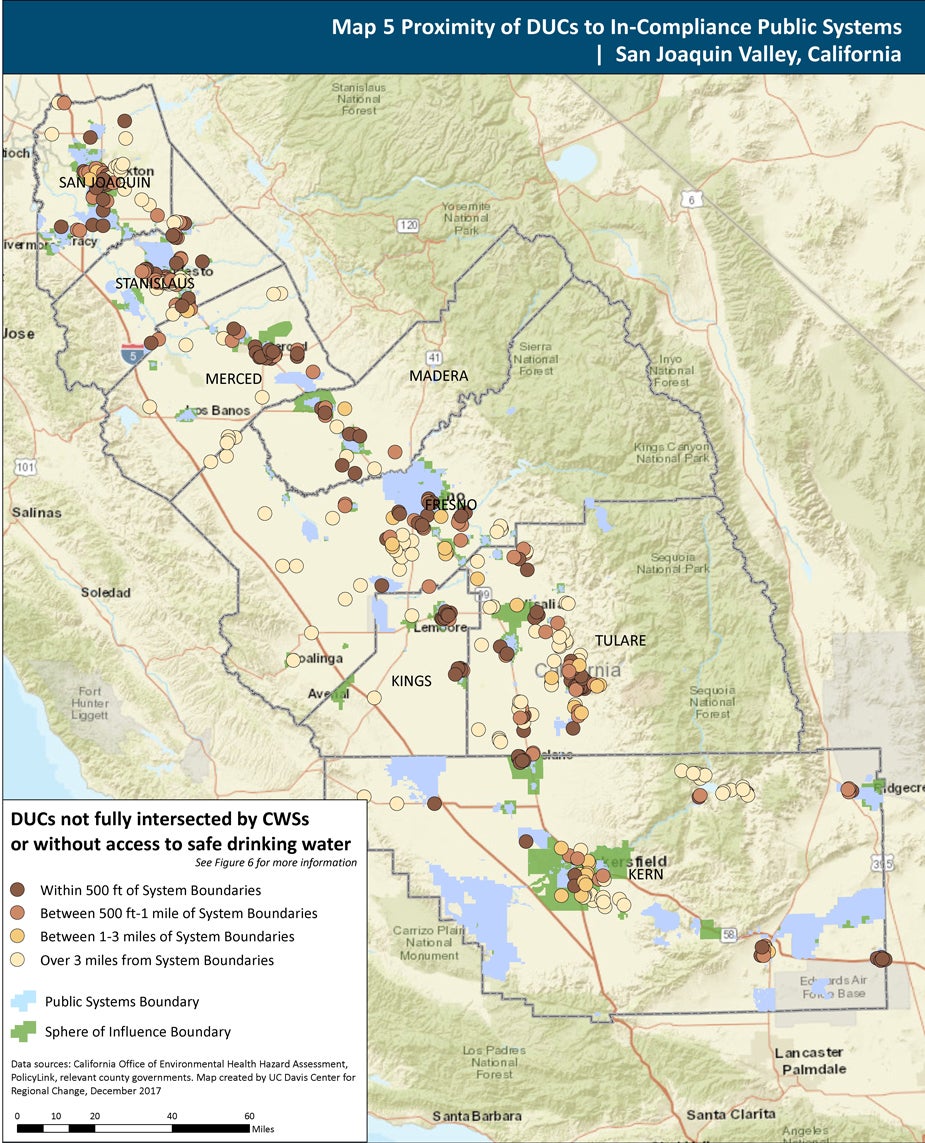
However, a University of California, Davis, study that assessed water systems throughout the valley found that safe water is often close at hand. Most people without safe water, or about 99,000 residents, live near public systems with clean water. They could access that water if service extensions, piping and other infrastructure were implemented, the report found.

Each Dot represents a community without safe drinking water, and the dot’s color indicates the distance from a source of safe water. Click on this link to view the whole map: https://www.ucdavis.edu/sites/default/files/news/campus-news/2018/mar/map-karen-925.jpg “There are solutions,” said Jonathan London, associate professor, director of the
Click here to see the full map. Each dot represents a community without safe drinking water, and the dot’s color indicates the distance from a source of safe water.
Some of that work is already happening. Students in the UC Davis School of Law Aoki Water Justice Clinic have been meeting with these communities to secure funding to build that infrastructure. Law students are also working with community organizations seeking policy changes to increase access to safe drinking water for low-income Californians.
“We are confident that these communities, local water systems, and the state can work together to fund and encourage infrastructure improvement to ensure that no one in the San Joaquin Valley need worry about what is coming out of their faucets,” London said.
The report, “The Struggle for Water Justice in the San Joaquin Valley: A Focus on Disadvantaged Unincorporated Communities,”looked at access to safe drinking water in low-income communities without city governments in the eight counties of the San Joaquin Valley.
The study’s purpose is to inform state policy and local planning in order to improve access to safe drinking water for these communities.
“Within the next decade and with adequate funding, we could solve a problem that has plagued low-income, rural communities for over 50 years,” said Camille Pannu, the water justice clinic director who also contributed to the report.
Success stories are found already in Tulare and Kings counties – The report found that more communities need to follow the examples from Kings and Tulare counties, where residents with unsafe water recently consolidated some water delivery systems and added lines to provide safe drinking water to residents. Previously, the people in the affected communities had dangerous levels of arsenic and nitrates in their water supplies.
Using a combination of solutions, the communities forged agreements among existing water agencies and obtained grants to help finance the changes, and in some cases, the state ordered consolidations.
The poor and people of color are adversely affected – People of color made up a majority of those without safe water, the Center for Regional Change study found. For example, while Hispanics make up just under half, or 49 percent, of the total population of the San Joaquin Valley, they represent more than two-thirds of residents in these unincorporated communities and 57 percent of all residents served by out-of-compliance water systems. Caucasians account for about 36 percent of those receiving water from unsafe systems.
Those without safe water face additional economic burdens as they need to augment their water needs by buying bottled water, or purchasing filter systems, for drinking and cooking.
Study proposes practical solutions:
Ways safe drinking water can be achieved, according to the report, include:
- Develop and strengthen consolidation and service extension mandates and incentives for cities, counties and community water systems.
- Create larger, more stable, and more equitably distributed and coordinated sources of funding for drinking water systems.
- Improve public access to data and planning tools; enhance existing data systems and coordinate water monitoring efforts.
The research began in fall 2016, and was funded by Resources Legacy Fund and the Water Foundation.
School of Law Water Justice Clinic – The Aoki Water Justice Clinic combines transactional law, policy advocacy and strategic research to ensure low-income California communities receive clean, safe and affordable drinking water. Established in 2017, it is believed to be the first law school clinic of its kind in the country.
- Law students in the clinic have worked in 13 low-income, rural communities in Fresno, Kern, Lake, Mono, Sonoma, Tulare and Tuolumne counties.
- Through their work, students have extended (or are in the process of extending) access to safe drinking water to 15,800 Californians.
- Four students are providing on-the-ground community organizations with policy research and analysis for state legislation introduced this year.
- Students are leading or supporting research collaborations, including partnerships with the UC Davis Center for Regional Change, UC Cooperative Extension and the UC Berkeley School of Law’s Wheeler Water Institute.
-
Backyard Chickens Need More Regulation
Davis, Calif., (March 13, 2018) – Historically, keeping backyard chickens was a response to economic hardship — whether it was in the Depression or during wartime food rationing.
But a growing number of chickens today are roaming or are caged on small family farms and in backyards, as suburban and urban poultry gains more popularity among consumers. Many people prefer to raise their own food because they think it will be safer, fresher and more nutritious than that which was commercially raised. Yet, a new University of California, Davis, study suggests that local ordinances are not adequately addressing human and animal health when it comes to backyard poultry, and laws that do exist do not keep pace with those for commercial growers.
“Ironically, as people seek to take control over the way their food is grown, most ordinances fail to ensure basic health and welfare for birds and humans,” said Catherine Brinkley, assistant professor of community and regional development, in the College of Agricultural and Environmental Sciences. She is the primary author of the study.
The paper, “A Method for Guarding Animal Welfare and Public Health: Tracking the Rise of Backyard Poultry Ordinances,” was recently published in the Journal of Community Health.
What needs to happen, the author recommends, is that there be more laws that mandate vaccinations, manure management and general animal welfare in urban and suburban settings similar to policies and regulations imposed on commercial chicken ranches.
“Provisions governing animal slaughter and routine veterinary care are rare, presenting a concern for monitoring and intervening in public health crises,” the study says. “In addition, shelters anticipate higher poultry intakes, particularly as unwanted birds are turned loose to become strays.”
Researchers focused their study on 100 municipalities in Colorado, the only state to compile public data for animal shelter surrenders and other statistics. Compared with three other U.S. cities — Los Angeles, Miami and New York — Denver had the highest percentage of respondents in favor of allowing backyard poultry, 62.5 percent, and the lowest percentage of respondents who believed urban poultry would lead to more human disease, at 7.4 percent. Almost 42,000 households across the four cities were surveyed.
Almost all the laws governing poultry-keeping in Colorado were passed since 2000.
“More poultry ordinances have been passed or modified in Colorado in the last five years than in the previous hundred,” Brinkley said.
The most common guidelines for poultry ordinances, the researchers found, pertain to housing design, placement and the sex of birds — some municipalities ban roosters altogether, some do not, and still others permit one rooster per 12 hens, for example. But regulations pertaining to cleanliness, ventilation, and food and water requirements are often lacking. Ordinances governing the slaughter of backyard chickens occur in only half of municipalities in Colorado, and many are vague, researchers found.
Regulations pertaining to the chickens’ health and welfare were rare in the Colorado study, with only 2 percent of municipalities including poultry under animal cruelty and abuse regulations.