Category: Ag Economics

  • Low-Dust Harvesting Now a Conservation Management Practice

    Growers required to have a Conservation Management Practice (CMP) plan in the San Joaquin Valley for dust reduction have received some favorable news. The San Joaquin Valley Air Pollution Control District (SJVAPCD) announced an update to their list of approved practices to reduce dust emissions, now including the use of low-dust harvesters.

    The SJVAPCD Conservation Management Practices, Rule 4550, was adopted in 2004. The purpose of the program is to reduce dust emissions, both PM10 and PM2.5, from agricultural sites. Growers with 100 acres or more in the district must provide a CMP plan, choosing to participate in dust-reducing practices across several categories. In April 2024, the SJVAPCD approved the addition of Low-Dust Nut Harvesters as an approved practice for the nut crops harvest category.

    Benefits of Low-Dust Harvesters

    Low-dust harvesters are designed to minimize the amount of particulate matter released into the air during the harvesting process. These machines employ advanced technologies that reduce the turbulence and agitation of soil and debris, which are primary sources of dust. The benefits of using these harvesters extend beyond regulatory compliance:

    • Improved Air Quality: Reduced dust emissions lead to better air quality, benefiting both agricultural workers and neighbors.
    • Enhanced Worker Health: Lower dust levels mean fewer respiratory issues and related health problems for farmworkers, promoting a safer working environment.
    • Environmental Impact: Decreasing dust emissions helps protect the local ecosystem, including plant and animal life that can be affected by poor air quality.
    Implementation and Cost Considerations

    Growers can take advantage of low-dust harvest technology by either contracting with a custom harvester who uses the equipment or replacing a conventional harvester or sweeper they currently use. For both options, there are incentive programs available to growers.

    If a grower is interested in purchasing low-dust harvest equipment, both NRCS and the SJVAPCD offer significant cost-share assistance to help purchase the equipment:

    • Through NRCS’s EQIP program to replace old in-use harvesting equipment, low-dust harvesters can receive up to $1,174.80 per horsepower (hp), while tractors and most other equipment can receive payments of $517.85 per brake horsepower (bhp) for 25-160 bhp and $806.60 per bhp for greater than 160 bhp.
    • Through the SJVAPCD’s program to replace conventional harvesters or sweepers, growers can receive 50% of the equipment cost and up to a maximum of $150,000 per unit. Growers can also apply for up to five pieces of equipment.

    If growers currently use or are interested in using a custom harvester that has low-dust equipment, USDA-NRCS offers a by-acre cost-share incentive to help pay for the practice at a rate of $66.82 per acre.

    For both incentive options, applications should be submitted well in advance of using or buying the equipment, and both programs also have several eligibility requirements. Contact your local San Joaquin Valley Air District Office or local NRCS office for more information. — By the Almond Board of California

  • General Irrigation Tips for Young Pistachios

    Pistachio acreage in California has been steadily increasing in recent years. A recent report by the Administrative Committee for Pistachios puts the bearing acreage of pistachio in California at about 461,000 acres, and the non-bearing acreage at about 144,000 acres. The average acreage for new yearly plantings for the last five years is about 29,000 acres. Much of the new plantings are in areas in the southern San Joaquin Valley that have moderate to high salinity. Generally, young pistachio trees are those that of non-bearing age.

    In California, pistachio is usually planted at row spacings of 20 to 22 feet and tree spacings of 15 to 20 feet. In ideal circumstances, the tree grows to cover most of this space by the time it reaches maturity. The amount of orchard space that the tree canopies shade at any given time is a critical component that goes into the estimation of how much water the trees need as they mature. For mature pistachio trees, the intermittent estimation of the crop water requirement (evapotranspiration) is relatively easier to determine due to the availability of research-developed water use curves (crop coefficients) for pistachio trees. In the southern San Joaquin Valley, a mature pistachio tree requires about 46 inches of water every season; with a peak daily demand of about 0.34 inches per day during hottest summer days. Research has shown that the evapotranspiration of tree crops generally tends to reach its maximum by the time the orchard floor area shaded by the tree canopies is between 50 and 60%. Young pistachio evapotranspiration is estimated by multiplying that of a mature tree by an adjustment factor. For example, the crop water demand of a first-leaf pistachio tree, on a peak evapotranspiration summer day is about: 0.34 in./day multiplied by an adjustment factor of 0.1, which yields a value of 0.034 inches per day. Adjustment factors for drip irrigated pistachio in the southern San Joaquin are as follows: 0.10 for year 1; 0.20 for year 2; 0.30 for year 3; 0.40 for year 4; 0.52 for year 5; 0.65 for year 6; 0.78 for year 7; 0.90 for year 8; 1.00 for year 9 and older. For more information on these adjustment factors, visit the website of the University of California Cooperative Extension Kern County Office.

    Figure 1 Button dripper installed on an irrigation lateral

    Like many orchard crops grown in California today, pistachio trees are mainly irrigated using microirrigation devices; which are designed to ensure irrigation efficiencies of at least 90% and above. Microirrigation devices operate at low pressures (3 to 20 psi), apply water at low rates (as low as 0.5 gph to highs of 10 to 20 gph), and more precisely compared other pressurized irrigation methods. Examples of microirrigation devices include: inline drip, micro-sprinklers and micro-sprays (sometimes called fan-jets), button drippers.

    In the first years of its growth, a young pistachio tree spends most of its energy on vegetative growth. Its canopy is very small and only covers a small fraction of its assigned tree area; implying that it has a relatively small evaporative surface. To efficiently irrigate a young pistachio tree, it is important to ensure that water is directly applied to the area close to the base of the tree and is concentrated to the rootzone. This approach mitigates water and nutrient loss through deep percolation and/or evaporation, and is generally recommended for widely spaced crops. Effort should be made to avoid applying water to the spaces where there isn’t significant root growth – such as the midway point between successive young trees – and this can be achieved by selecting the appropriate irrigation device. For young pistachios, button drippers are recommended because they can be installed close to the tree. Button drippers usually have flow rates ranging from 0.5 to 2 gph. To install a button dripper, the irrigation lateral is punctured to create a small hole which is then plugged with the emitter. For newly potted trees, the dripper should be positioned to apply water directly to the root ball for about 30 days. After the roots have grown into the surrounding soil, one or two button drippers can be installed at least one foot off either side of the trunk. As the tree grows each year, additional button drippers are added onto the lateral; much further away from the trunk. It is important to take note of the flow rate of the drippers, peak evapotranspiration of the tree and soil water holding capacity vis-à-vis state of root growth, when deciding the number of emitters to install as the tree grows. If a grower prefers, the button drippers could be replaced by micro-sprinklers or micro-sprays when the trees are mature and/or when most of the orchard canopy is closed.

    To promote root growth in young established trees, it is recommended that they are not frequently irrigated as an imposition of mild stress conditions spurs roots to grow in search of water and nutrients. However, newly transplanted trees may require more frequent irrigation during the initial stages while their roots grow into their immediate soil surroundings. In irrigation practice, the amount of water applied, when it is applied, is determined by the water storage capacity of the managed rootzone, and in accordance with an allowable water depletion rate. This is called irrigation scheduling. The rootzone water storage capacity is mainly determined by soil texture. It is therefore important to find out what type of soil is found in the orchard when determining an irrigation schedule. This is especially important when microirrigation methods are managed to apply water only to the rootzone of young trees. Light (sandy) soils tend to have lower lateral water redistribution and retention capacities. In such soils, more frequent but low volume irrigation may be recommended. On the other hand, very heavy clay soils – though having higher water retention abilities – may also require frequent irrigation because a significant bit of much of the water stored in them is not available to the trees. Soils with the highest water storage capacity tend to be silt-loams.

    To aid irrigation management, it is recommended that growers utilize soil moisture probes. These are widely available in the market. Stem water potential of young pistachio trees can be monitored using the hand-held pump-up pressure chamber since their stems are usually thin for high-tech plug-in sensors. Although there is no research developed baseline values of SWP for pistachio trees – unlike almonds for example –, it is recommended that the irrigation strategy for young trees should be to avoid prolonged conditions of water stress. To this, the SWP should be maintained between -9 to 10 bars often. It is also advisable to monitor soil moisture close to the base of tree and at multiple points of the rootzone. To do this, for an example, a probe could be placed within one foot of the tree or dripper, and soil moisture monitored at depths of one and two feet. If funds permit, and depending on the type to device chosen, a longer soil probe – 4 to 6 feet – could be installed to monitor moisture at greater depths, in the long run as the tree grows to maturity. In order to get an orchard-wide overview of the soil moisture status at any time, it is recommended to install several sensors at different locations within the field. To determine the number of sensors and installation locations within a field, a soil map such as that provided by as the USDA’s Web Soils Survey, or UC Davis’s SoilWeb application is helpful. Alternatively, a lab test of soil samples taken from different locations in the field, could be used to guide soil probe installation. Most sensors available in the market report soil moisture either as volumetric water content, or as a soil tension force. Irrespective of units, from an irrigator’s perspective, the values of interest are the field capacity and permanent wilting point of soil at the site and the reading returned by the probe at any given time. For orchards on loamy soils, moisture depletion up to the midpoint value between field capacity and permanent wilting point (or 50% moisture depletion), before resumption of irrigation is considered to be acceptable.

    Lastly, the performance of an irrigation system can also be limited by the general state of the “health” of the soil of an orchard site. For example, soils which are highly compacted and/or sodic significantly limit soil water infiltration; leading to water loss. Therefore, when establishing new orchards in “tough” soils, it may be beneficial to carry out some practices to improve the physical, chemical and biological properties of the soil. This may involve actions like tilling to break soil crust, applying amendments to reduce salinity or sodicity and adding organic matter.

    Many factors are part of the equation of economically sustainable pistachio production. Efficient water use is one of those, which is particularly important in a state like California where production is heavily reliant on irrigation.

    For more information about pistachio irrigation, please call the UCCE-Kern Soils and Irrigation Advisor or visit the website of the University of California Kern County Cooperative Extension office. — By Tobias E. Oker, Soils & Irrigation Advisor, UC Cooperative Extension, Kern County

    University of California, Agriculture and Natural Resources

    Office phone: (661) 868-6218 | Email: teoker@ucanr.edu

  • Carbohydrates, Dormancy, and Yield in Pistachios

    Did we get enough chill over the winter? What are yields going to look like this fall? One relatively new area of research, carbohydrate dynamics, is shedding light that may help answer these questions. Recent years of research by the Zwieniecki lab (the Z Lab) at UC Davis, including the Carbohydrate Observatory, have been providing exciting new insights to better explain how pistachios may be counting winter chill, when budbreak occurs, and how much pistachios will yield in a given year. While many areas remain to be investigated, this research is starting to provide insight into how management can influence carbohydrates, which in turn influence dormancy, budbreak and yield.

    What Are Carbohydrates?

    A few definitions are helpful before we dive into discussion. Non-structural carbohydrates (NSC) are carbohydrates that are not part of structures like cell walls. NSC are utilized by the tree for energy, as building blocks for cell growth, as an osmolyte to influence water dynamics, and as signals for multiple physiological activities. NSC are either in the form of sugars or starch. Sugars are the product of photosynthesis, and the building blocks of starch. Sugars are also an active part of biological cell activity and their level in cells are under strict control. Starch is the storage form of carbohydrates and can later be broken down to provide sugars.

    How Do Carbohydrates Vary Over the Year?

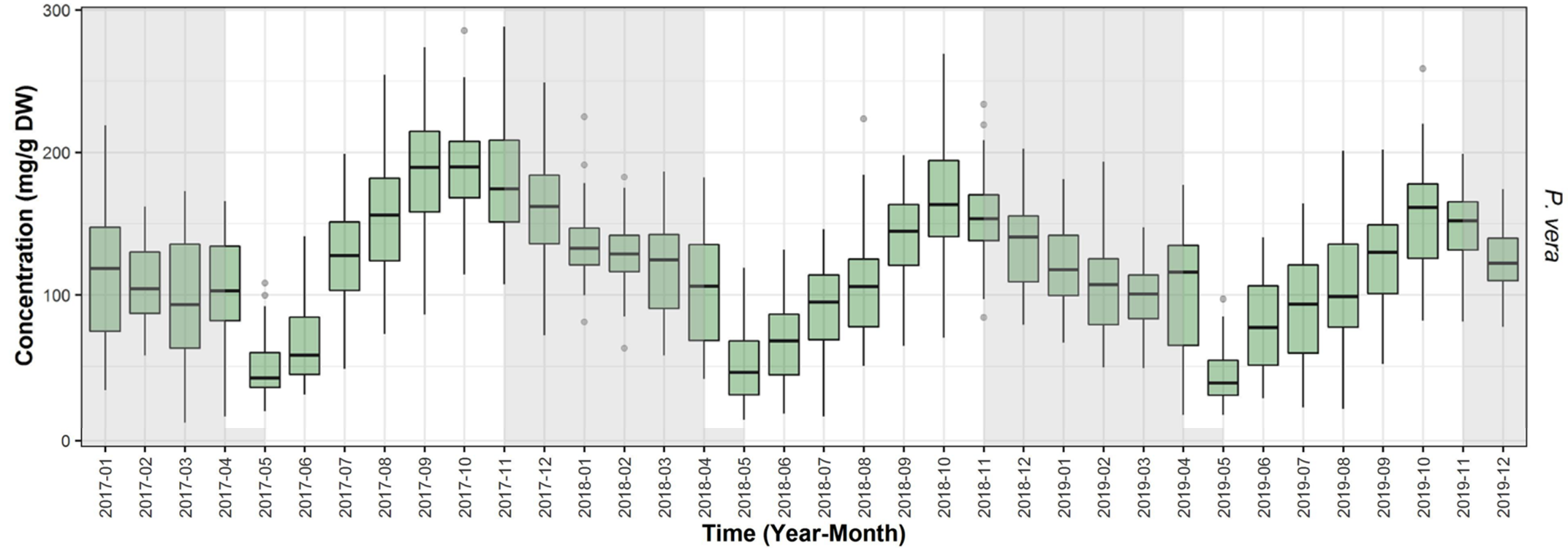
    An intensive sampling was conducted of carbohydrates of almonds, pistachios and walnuts in the twig, branches and trunk over the course of a year. As has been seen in other temperate trees, it was found that NSC varies with changing stages of growth or phenology, and concurrent climatic conditions. NSC decreases following bud break, reaches the lowest levels during the growing season, and then increases starting mid-to-late summer to reach maximum levels in fall or early winter (Figure 1). By following the amounts of NSC in a plant over time, we can build a better understanding of how trees are using carbohydrates for current opportunities (vegetative and fruit growth) or future challenges (dormancy, defense against pathogens and other stressors).

    Carbohydrate Dynamics Predict Bloom

    Exactly how trees track the accumulated experience of winter cold and spring heat to “know” it’s time to break dormancy in the spring has remained somewhat mysterious. The Carbohydrate Observatory has found that in almonds, pistachios, and walnuts, shortly before bud break, there is a surge in starch and a dip in sugar concentration. The Z Lab has used this knowledge to create a model for bloom timing, based on fall and winter carbohydrate and temperature dynamics. This bloom prediction model integrates some important aspects about how plants balance sugar and starch concentrations. When it is warm, trees turn sugars into starch, and when it’s cold, trees turn starch into sugar. For trees to keep sugar levels in an optimum range, they adjust the concentration of the enzymes responsible for this starch synthesis and degradation. Because starch synthesis is very temperature sensitive, but starch degradation is not, trees can quickly respond to too much sugar at warm temperatures but can’t respond as quickly to too little sugar. When conditions warm up in the spring, starch synthesis quickly takes off, pulling sugars out of circulation, resulting in a dip in sugar. This dip in sugar and upsurge in starch is predictive of (and may even trigger) bud break.

    Figure 1. Average concentration of NSC (sugars and starches) from more than 40 pistachio orchards from January 2017 to December 2019. The center bar of each green box shows the average for that month, the box shows the zone where half of all the values from that month lie (25% above and below the average) and the whisker lines show more extreme values. Grey shading reflects the dormancy period. (Davidson et al., 2021. Sci. Reports)

    Because of the different temperatures sensitivities of the different enzymes, cold winters, somewhat counter-intuitively, would amplify accumulation of starch synthesis enzymes, resulting in less warm time necessary in the spring to trigger a sharp sugar drop and bloom. Warmer winters would downregulate starch synthesis, requiring more warmth than normal in the spring to achieve low sugar levels. By integrating this knowledge of the principles of carbohydrate dynamics and specific thresholds and ranges learned from the Carbohydrate Observatory, pistachio budbreak was predicted within 7 days on average (Sperling et al 2021). While this may not be accurate enough for management decisions, it’s close enough to support integrating these carbohydrate dynamics into our understanding of how trees count the passing of winter and spring.

    Using this model, they could then extrapolate the impacts of sugar concentrations going into winter. Going into winter with higher sugars, a metric of having built up higher NSC reserves over the growing season, results in earlier bloom, functioning almost like having experienced more chill. Lower sugars results in later bloom. This is supported by other recent research (Amico Roxas et al, 2021), that found that early defoliation in the fall decreased NSC going into winter and delayed budbreak in the spring, whereas girdling branches in October (which keeps more carbohydrates in the shoots) moved budbreak earlier.

    Carbohydrates and Yield

    Because carbohydrates are both the energy currency of plants and are used to make structures like cell walls, they are critical to growing pistachio fruit during the summer. NSC concentrations stay low during the growing season, as the carbohydrates made by photosynthesis get channeled into growing the crop, and sometimes into growing vegetation. New research is showing this interplay of carbohydrate sinks, photosynthesis and nitrogen demands may help explain alternate bearing habits of pistachio. UCCE Orchard Specialist Giulia Marino has recently looked into these dynamics by either partially defoliating bearing branches to reduce carbohydrate sources, or partially stripped off growing fruit to reduce carbohydrate sinks. She found that branches with a lot of leaves relative to the number of fruits actually increased photosynthesis during kernel fill, presumably in response to the strong carbohydrate demand of nearby fruit. However, branches with a lot of fruit set decreased photosynthesis after kernel fill. This may seem counter-intuitive (shouldn’t they ramp up photosynthesis even more?), until they found that nitrogen in the leaves of those branches was decreasing at the same time that photosynthesis was dropping. This is likely because nitrogen was remobilized from the leaves to the kernels, hindering the nitrogen-related components of the photosynthetic process. Why does this concern us, from a production standpoint? Because this change would then result in lower carbohydrate availability for buds being created for the following year’s crop, leading to alternate bearing.

    Relatedly, Dr Zwieniecki, looking across almonds, pistachios and walnuts data from the Carbohydrate Observatory and yields provided by growers, sought to see if there was a relationship between NSC in different months of the year and yield (Zwieniecki et al 2023). He found that in pistachios there’s a strong, consistent correlation between NSC in wood and bark in the fall and winter (October through March) with yield the following year, particularly the starch component of total NSC,. This relationship was most pronounced in December, shortly after leaf drop. The higher the starch in the wood of pistachio twigs, the higher the yield turned out to be the following year. Given Marino’s findings of how carbohydrates relate to alternate bearing, this high starch-high yield relationship is likely in part a matter of correlation – following a low set “off” year, Marino’s research indicates you’d go into winter with more female flower buds and more carbohydrates. However, higher winter NSC was also found to be related to higher yields in almond and walnut, which don’t have this alternate bearing complication. This indicates that yields are likely also higher following a high carbohydrate winter because there’s more gas in the carbohydrate tank to fuel the growth needs of the crops the following season.

    What’s this all mean for production?

    The relationship between chill, heat and carbohydrates helps us understand why warm winter temperatures, and warmed wood and buds in low fog winters lead to delayed and protracted budbreak. This also explains why chemical sprays that interfere with respiration (cells turning sugar into energy) and reflectants (e.g. kaolin clay) that keep wood temperature lower could help compensate for lower chill. More work is needed to help fine tune the use of this knowledge, say to know how warm temperatures need to be to make reflectants worth the expense, or when the optimal time is for spraying dormancy breaking treatments.

    The strong relationship between high NSC going into winter, strong yields and normal bloom timing suggest that late season management that helps send orchards into dormancy with higher amounts of NSC leads to positive outcomes of budbreak timing and yield. Irrigation and foliar disease management that can keep leaves healthy and producing new sugars well into October should benefit this NSC accumulation. Stresses that lead to early defoliation would have the opposite effect. The next step in research is to look into other factors can influence this relationship (Variety or rootstock selection? Nutrient management to keep leaves healthy and photosynthesizing?), and whether they have enough influence to merit the expense. — By Katherine Jarvis-Shean (UCCE Orchard Advisor, Sacramento, Solano & Yolo Counties) and Maciej Zwieniecki (Dept. Plant Sciences, UC Davis)

  • Friends of the Fair Award $26,000 in Ag Scholarships

    Nine Solano County residents majoring in an agricultural field will share $26,000 toward their college educations, thanks to the Donnie and Tootie Huffman Scholarship Program of the Friends of the Dixon May Fair.

    The scholarship program is named for the Vacaville couple who set up the program. It memorializes founding president Donnie Huffman (1940-2023), who died June 17, 2023 of cancer, and honors his wife, Claudia (Tootie), the founding treasurer, who continues as a scholarship committee judge.

    Since 2000, the Friends of the Dixon May Fair has awarded a total of $274,750 to Solano County residents majoring in agriculture, announced Carrie Hamel of Dixon, the scholarship chair.

    For the second consecutive year, Sam Esperson, a 2022 graduate of Rio Vista High School and a student at California Polytechnic University (Cal Poly), San Luis Obispo, won the $5000 Donnie Huffman Presidential Scholarship, the highest award the program offers. He is majoring in agricultural systems management.

    Massimo Menicou of Vacaville, a 2024 graduate of Vacaville High School won the $4000 JoAn Giannoni Award, honoring a Dixon resident who is the founding secretary of the Friends. Menicou received an early acceptance to the University of Nevada. He plans to major in animal science (pre-veterinary medicine path).

    Natalie Victorine, of Dixon, a 2021 graduate of Dixon High School and a student at Cal Poly, won the $3500 Ester Armstrong Memorial Award. The award memorializes a former director of the California Division of Fairs and Expositions, who died in May 2009 of cancer. Armstrong, a Rocklin resident served as interim chief executive officer of the Dixon May Fair from 2006 to 2009.

    Elena Mendonsa of Vacaville, a 2024 graduate of Vacaville Christian High School, won the $3000 Joe Gates Memorial Scholarship, memorializing the longtime auctioneer of the Dixon May Fair Junior Livestock Auction. Gates, a Rio Vista resident, died of COVID in February 2021.

    Others winning $3000 scholarships in the university category:

    Megan Kett, a 2021 graduate of Dixon High School and a student at Oklahoma University; Bridget de Flores, a 2023 graduate of Rio Vista High School, and a student at Chico State University; Maya Ferris, a 2024 graduate of Vacaville High School with plans to attend Cal Poly; and Trevor de Rosier, a 2024 graduate of Angelo Rodriguez High School, Fairfield, enrolled at UC Davis.

    In the community college category, Cole Jacobson, a 2024 graduate of Dixon High School and an incoming student at Woodland Community College, won the $1500 Jack Hopkins Memorial Scholarship. Hopkins (1922-2009), a life-long resident of Fairfield and Suisun and a fruit rancher, was a strong support of the Junior Livestock Auctions at the Dixon May Fair and Solano County Fair.

    Carrie Hamel (far left), scholarship chair of the Friends of the Fair, and Linda Molina (far right), scholarship committee member, pose with seven of the nine winning scholars who shared $26,000 in college scholarships. Students from left are Cole Jacobson, Maya Farris, Trevor DeRosier, Megan Kett, Elena Mendonsa, Bridget De Flores, and Massimo Menicou. Not pictured are Natalie Victorine and Sam Esperson. Esperson is the recipient of the $5000 Donnie Huffman Memorial Scholarship, the top award. Sam’s mother represented him at the recent ceremony.

    Capsule information about the recipients:

    Sam Esperson. Esperson, interested in an agricultural engineering career, seeks expertise “in agricultural engineering, financial management, personnel administration and an overall agricultural systems management to uncover fresh opportunities within the industry,” he wrote in his application packet. His letters of support praised his leadership, professional development, work ethic, and collaborative spirit. He interned at Pacific Southwest Irrigation the summer of 2023 and was described as a “rising star” in the industry.

    Massimo Menicou. Menicou wrote that his end goal is to “become a doctor of veterinary medicine… As of now, large and small animal medicine are of interest to me. I attended a summer youth camp for veterinary care at Texas A&M the summer of 2023 and loved the exposure to cattle and swine.” He was both an athlete and a scholar at Vaca High. A member of the Future Farmers of America Veterinary Science Career Development Team, Menicou captained his high school football team and the Solano-Yolo Rugby Club. “Massimo is the type of student every teacher dreams of having in their class,” a teacher wrote in her letter of recommendation.

    Natalie Victorine. Victorine, majoring in agricultural communication, seeks a career in digital media management production. Her decision to major in ag communication was “spurred by my involvement in youth agricultural leadership organizations such as 4-H and FFA, combined with my strong familial roots in agriculture,” she wrote. Last November at the national FFA convention, she received her American FFA Degree, the highest award an FFA member can achieve. Her letters of recommendation praised her as a leader, and as “a hard-working, genuine and enthusiastic.”

    Elena Mendonsa. Mendonsa wrote that she seeks an animal science degree at UC Davis and hopes to attend the UC Davis School of Veterinary Medicine. She served as president of her school’s Environmental Club and won the top student award in anatomy and physiology and biomedical sciences. She interns at a local veterinary clinic and also with the Solano County SPCA. Her letters of support praised her academic excellence, leadership and social responsibility.

    Megan Kett. Kett, who seeks a career as a veterinarian, is a first-generation college student majoring in animal science, with a concentration in pre-veterinary animal science. She worked as an animal caretaker for the Oklahoma State University Veterinary Teaching Hospital in Stillwater, Okla. At Dixon, she raised market swine in the 4-H and FFA programs and was a member of the water polo and swim teams all four years of high school. “I am currently pursuing a position in the undergraduate scholar’s program, with a focus on research with swine,” she wrote. Agriculture has always been a part of her life. She helped her father plant and grow a walnut orchard on the Kett family farm in Dixon.

    Bridget de Flores. De de Flores is majoring in agricultural business at California State University, Chico. As a 10-year 4-H club member, she won a number of awards, including Supreme Grand Champion Turkey and Reserve Grand Champion Turkey. “My experience in 4-H has helped to better prepare me for my future career,” she wrote, adding that she plans career as a farm/ranch manager or as a farmer or rancher. Her letters of recommendation praised her as an outstanding leader and student, and “well-rounded.”

    Maya Ferris. Ferris plans to attend Cal Poly with a career goal of becoming a veterinarian. “I’ve always had an affinity for animals,” she wrote in her application packet. “Since I was a little girl, I’ve always had the precarious habit of seeking out animals an trying to bring them home, much to my parents’ displeasure…Over the years I have had the chance to shadow my local large animal veterinarian, Jason Bravos.” Her letters of support praised her as an outstanding leader and scholar, and active in FFA. She won the title of Miss Teen California and is a recipient of a FFA State degree.

    Trevor deRosier. He plans to major in wildlife biology at UC Davis. “I hope to learn as much as I can about wildlife biology and I would like to specialize in my primary interest, which is birds.” For his Eagle Scout project, he chose the California Raptor Center at UC Davis. “I led a group of Scouts in creating life-sized wooden cutouts of seven silhouettes of birds they have at the facility,” he wrote. “I displayed them on a wall at the Center to encourage more community members to visit the facility.” His letters of recommendation praise him for his diligence, leadership, and as a persistent hard worker.

    Cole Jacobson. Cole plans to major in agricultural business at Woodland Community College. In his application packet, he related “With agribusiness, I can tap into this industry from a financial or entrepreneurial perspective, two things that I am very interested in.” He added that “learning how to drive a tractor…(was) a huge stepping stone in my life.” His letters of recommendation described him as “a thoughtful, kind and a strong leader in our school and FFA community” and that “he never shies away from challenges, and new opportunities for learning.”

    The Friends, an all-volunteer, service-oriented organization, is the fundraising arm of the Dixon May Fair. Headed by president Gilbert “Gil” Molina of Vacaville, the organization raises funds through the sale of beverages at the four-day fair, and donates the proceeds for building and grounds improvements, college scholarships and exhibitor awards.

    Applicants are scored on personal, civic and academic experience; academic standing; personal commitment and established goals; leadership potential; and civic accomplishments. Most applicants have experience in 4-H, FFA or Grange–criteria desired but not mandated.

    Continuing scholarship winners may apply up to four times, Hamel said. Scholarship checks can be used only for tuition, fees, books, materials and supplies, housing, and meals purchased on campus.

    The scholarship committee, chaired by Hamel, also includes Tootie Huffman, Kathy Keatley Garvey and Linda Molina, all of Vacaville, and Sue Miracle and Michelle Robinson of Dixon.

    The deadline to apply for the annual scholarships is March 1. In the past, rules mandated that the applicants “be attending a college or university within California.” As of 2024, the rules expanded to “a college or university within the United States,” Hamel said.

  • California DPR Awards $2.6M to Accelerate Adoption of Effective and Sustainable Pest Management

    The California Department of Pesticide Regulation (DPR) has announced $2.6 million in grant funding awarded to eight projects that advance the adoption of safer, more sustainable pest management.

    The department awarded $1.72 million in Research Grants to fund projects that advance integrated pest management (IPM) knowledge, tools and practices. DPR additionally awarded $942,000 in Alliance Grants to fund projects that promote or increase sustainable pest management though the implementation, expansion and adoption of effective, proven and affordable IPM systems or practices.

    Over the past 20 years, DPR has awarded more than $26 million for over 100 projects that advance the use of IPM. Previously funded Alliance and Research Grant projects are available on DPR’s website.

    “We are excited to support the research, testing and work of our grant awardees that expands options for safe and effective ways to manage pests,” said DPR Director Julie Henderson. “Pest management is critical to protect people and our environment, to support our infrastructure, and to provide a healthy and sustainable food supply. The innovation reflected in our Research and Alliance Grant Awards is key to combating — in safe, sustainable ways — the mounting pest pressures driven by our changing climate. ”

    Both grant programs sought applications that addressed more than one of the Sustainable Pest Management Roadmap’s defined sustainability pillars, including human health and social equity, environmental protections and economic vitality, or one or more of the following topic areas:

    • Advancing IPM for underserved or disadvantaged communities.
    • Decreasing the use of high-risk/high-volume pesticides (such as fumigants like 1,3-dichloropropene or sulfuryl fluoride).
    • Advancing urban IPM and safer, more sustainable pest management tools and strategies in urban settings.
    • Advancing IPM and safer, more sustainable pest management tools and strategies in agricultural settings, particularly in settings adjacent to or near schools.
    • Meeting the IPM needs of small growers.

    Research Grants Program recipients:

    • Developing pest resistant plant breeds to reduce fumigant use: $460,663

    Dr. Shahid Siddique, Associate Professor of Entomology and Nematology at University of California, Davis, will investigate a plant gene for its ability to help tomato plants resist infection by nematodes. Dr. Siddique’s efforts are intended to reduce the need for soil fumigation to control these destructive parasites.

    • Developing drone software for releasing beneficial biocontrol organisms: $252,771

    Dr. M. Khalid Jawed, Associate Professor of Mechanical and Aerospace Engineering at University of California , Los Angeles, will design and test software capable of flying drones in high tunnels used for crop production. Dr. Jawed’s team will then test the use of these drones for dispersing biocontrol organisms, which may offer a safer, cost-effective alternative to the use of pesticides in these spaces.

    • Identifying resistant Botrytis and exploring alternatives for pest management in greenhouses: $256,093

    Dr. Johanna Del Castillo Múnera, Assistant Professor of Cooperative Extension at University of California, Davis, will test samples of Botryritis spp. recovered from greenhouses for resistance to commonly used pesticides. Dr. Del Castillo Múnera’s project will then evaluate a variety of safer, more sustainable pest management options for Botrytis management, including biocontrol organisms.

    • Using agricultural plant waste to combat soilborne pests: $353,491

    Dr. Christopher Simmons, Department Chair and Professor of Food Science and Technology at University of California, Davis, will evaluate the use of postharvest “waste” material from California agricultural production, including grape pomace and almond hulls, for their use in biosolarization of agricultural fields. Biosolarization takes soil that has been combined with organic matter and uses sunlight to heat the soil and maintain it at a temperature that kills pathogens. These underutilized materials may offer a low-cost input that could assist in reducing the use of soil fumigation to combat a variety of soilborne pests and pathogens.

    • Exploring walnut materials’ impact on nematode management: $401,090

    Dr. Andreas Westphal, Professor of Cooperative Extension in Nematology at University of California, Riverside, will test the use of compounds found in walnuts and walnut hulls for their ability to combat soil nematodes that cause significant damage in California orchards, particularly during early growth stages. Dr. Westphal’s project will ideally reduce the need for soil fumigation, especially during pre-planting, for California nut production.

    Alliance Grants Program recipients:

    • Integrating IPM into Medi-Cal: $283,183

    Anne Lamb, Director of Regional Asthma Management & Prevention, a Project of the Public Health Institute, will educate Medi-Cal Asthma Remediation (AR) providers about IPM. This will ensure that when pests are identified through AR in the homes of low-income Californians, these pests are addressed through IPM practices.

    • Minimizing rodenticides through detection and monitoring: $491,549

    Luis Agurto, Chief Executive Officer of Pestec, will deploy a network of sensors and create a digital application that will organize, store and share data related to rodent pest management, particularly regarding the implementation and efficacy of alternatives to rodenticides. These data will ideally encourage and accelerate the adoption of these alternatives.

    • Developing an IPM program in Vista: $167,203

    Yale Jeffery, Public Works Supervisor at the City of Vista, will develop an IPM program for the city that is focused on more sustainable weed management. Jeffery’s project will ideally serve as a model for other urban areas seeking to eliminate or reduce herbicide use.

    El DPR otorga $2.6 millones en fondos de subvención para acelerar la adopción de un manejo de plagas seguro, efectivo y sostenible en California

    La financiación apoyará cinco proyectos de investigación y tres proyectos de divulgación para promover la adopción del manejo integrado de plagas (IPM) en la agricultura y en entornos urbanos 

    SACRAMENTO – El Departamento de Reglamentación de Pesticidas (DPR) de California anunció hoy fondos de subvención de $2.6 millones otorgados a ocho proyectos que promueven la adopción de un manejo de plagas más seguro y sostenible.

    El departamento otorgó $1.72 millones en subvenciones de investigación para financiar proyectos que promuevan el conocimiento, las herramientas y las prácticas de manejo integrado de plagas (IPM). El DPR otorgó además $942,000 en subvenciones de la Alianza para financiar proyectos que promuevan o aumenten el manejo sostenible de plagas a través de la implementación, expansión y adopción de sistemas o prácticas de IPM efectivos, probados y asequibles.

    En los últimos 20 años, el DPR ha otorgado más de $26 millones para más de 100 proyectos que promueven el uso de IPM. Los proyectos de subvenciones de investigación y de la Alianza financiados anteriormente están disponibles en el sitio web del DPR.

    “Nos entusiasma apoyar la investigación, las pruebas y el trabajo de nuestros beneficiarios de subvenciones que amplían las opciones de formas seguras y efectivas de manejar las plagas”, dijo la directora del DPR, Julie Henderson. “El manejo de plagas es fundamental para proteger a las personas y nuestro medio ambiente, para apoyar nuestra infraestructura y para proporcionar un suministro de alimentos saludable y sostenible. La innovación reflejada en las subvenciones otorgadas de investigación y de la Alianza es clave para combatir, de manera segura y sostenible, las crecientes presiones de plagas impulsadas por nuestro clima cambiante”.

    Ambos programas de subvenciones buscaron aplicaciones que abordaran más de uno de los pilares de sostenibilidad definidos por la Hoja de Ruta para el Manejo Sustentable de Plagas, incluida la salud humana y la equidad social, la protección ambiental y la vitalidad económica, o una o más de las siguientes áreas temáticas:

    • Ampliación del IPM para comunidades desatendidas o desfavorecidas
    • Disminución del uso de pesticidas de alto riesgo / alto volumen (como fumigantes como 1,3-dicloropropeno o fluoruro de sulfurilo)
    • Progreso del IPM urbano y de las herramientas y estrategias de gestión de plagas más seguras y sostenibles en entornos urbanos
    • Progreso del IMP y de las herramientas y estrategias de gestión de plagas más seguras y sostenibles en entornos agrícolas, particularmente en entornos adyacentes o cercanos a las escuelas
    • Satisfacción de las necesidades del IPM de los pequeños productores

    Beneficiarios del Programa de Subvenciones de Investigación:

    • Desarrollo de variedades de plantas resistentes a las plagas para reducir el uso de fumigantes: $460,663

    El Dr. Shahid Siddique, profesor asociado de Entomología y Nematología en la Universidad de California, Davis, investigará un gen vegetal por su capacidad para ayudar a las plantas de tomate a resistir la infección por nematodos. Los esfuerzos del Dr. Siddique están destinados a reducir la necesidad de fumigación del suelo para controlar estos parásitos destructivos.

    • Desarrollo de software de drones para liberar organismos de biocontrol beneficiosos: $252,771

    El Dr. M. Khalid Jawed, profesor asociado de Ingeniería Mecánica y Aeroespacial en la Universidad de California, Los Ángeles, diseñará y probará software capaz de volar drones en túneles altos usados para la producción de cultivos. El equipo del Dr. Jawed probará el uso de estos drones para dispersar organismos de biocontrol, lo que puede ofrecer una alternativa más segura y asequible al uso de pesticidas en estos espacios.

    • Identificación de Botrytis resistentes y exploración de alternativas para el manejo de plagas en invernaderos: $256,093

    La Dra. Johanna Del Castillo Múnera, profesora asistente de Extensión Cooperativa en la Universidad de California, Davis, analizará muestras de Botryritis spp recuperadas de invernaderos para determinar su resistencia a los pesticidas de uso común. El proyecto de la Dra. Del Castillo Múnera evaluará una variedad de opciones de manejo de plagas más seguras y sostenibles para el manejo de Botrytis, incluidos los organismos de biocontrol.

    • Uso de desechos de plantas agrícolas para combatir plagas transmitidas por el suelo: $353,491

    El Dr. Christopher Simmons, profesor de Ciencia y Tecnología de Alimentos y presidente del Departamento en la Universidad de California, Davis, evaluará el uso de material de desecho poscosecha de la producción agrícola de California, incluido el hollejo de uva y las cáscaras de almendra, para su uso en la biosolarización de campos agrícolas. La biosolarización toma el suelo que se ha combinado con la materia orgánica y usa la luz solar para calentar el suelo y mantenerlo a una temperatura que mata a los patógenos. Estos materiales infrautilizados pueden ofrecer un insumo de bajo costo que podría ayudar a reducir el uso de la fumigación del suelo para combatir una variedad de plagas y patógenos transmitidos por el suelo.

    • Exploración del impacto de materiales de nuez en el manejo de nematodos: $401,090

    El Dr. Andreas Westphal, profesor de Extensión Cooperativa en Nematología en la Universidad de California, Riverside, probará el uso de compuestos que se encuentran en nueces y cáscaras de nueces por su capacidad para combatir los nematodos del suelo que causan daños significativos en los huertos de California, particularmente durante las primeras etapas de crecimiento. El proyecto del Dr. Westphal reducirá idealmente la necesidad de fumigación del suelo, especialmente durante la etapa previa a la siembra, para la producción de nueces de California.

    Beneficiarios del Programa de Subvenciones de la Alianza:

    • Integración del IPM en Medi-Cal: $283,183

    Anne Lamb, directora de Manejo y Prevención Regional del Asma, un proyecto del Instituto de Salud Pública, educará a los proveedores de Remediación del Asma (AR) de Medi-Cal sobre el IPM. Esto asegurará que, cuando se identifiquen plagas a través de AR en los hogares de californianos de bajos ingresos, estas plagas se aborden a través de prácticas del IPM.

    • Minimización de rodenticidas a través de detección y monitoreo: $491,549

    Luis Agurto, director ejecutivo de Pestec, desplegará una red de sensores y creará una aplicación digital que organizará, almacenará y compartirá datos relacionados con el manejo de plagas de roedores, particularmente en lo que respecta a la implementación y eficacia de alternativas a los rodenticidas. Idealmente, estos datos fomentarán y acelerarán la adopción de estas alternativas.

    • Desarrollo de un programa del IPM en Vista: $167,203

    Yale Jeffery, supervisor de Obras Públicas de la ciudad de Vista, desarrollará un programa de IPM para la ciudad que se centra en un manejo más sostenible de las malezas. El proyecto de Jeffery servirá idealmente como modelo para otras áreas urbanas que buscan eliminar o reducir el uso de herbicidas.

  • Oakville Bluegrass Cooperative Opens Enrollment for USDA Incentive

    Oakville Bluegrass Cooperative opened enrollment for the inaugural year of the USDA climate-smart partnerships incentive to plant Oakville bluegrass, a summer-dormant perennial cover crop. Because Oakville bluegrass is dormant from April through September, it doesn’t compete with cash crops for water or nutrients making it ideal for California permanent crops. Planted on over 900 acres of vineyards and tree nut orchards, this low growing, drought tolerant cover crop will last over ten years when well managed, significantly reducing labor and input costs for growers. When well managed, this low growing, drought tolerant cover crop will last over ten years significantly reducing labor and input costs for growers.

    The first cohort of growers who take advantage of the USDA incentive can receive a $100/acre incentive per seeded acre of the cover crop on up to 150  acres. The incentive is part of the USDA’s Climate Smart Commodities Program to equip growers with resources to implement climate smart practices.

    In addition to the USDA incentive, Oakville Bluegrass Cooperative is offering free seed shipping and waiving install fees for a limited time for growers who commit to planting at least 20 seeded acres. Growers who are interested in participating in the USDA incentive and this special offer are encouraged to submit their preliminary plans soon in order to take advantage of these opportunities.

    “Oakville bluegrass occupies a unique place in the market as a permanent cover solution,” Mike Morgenfeld, Managing Director for Oakville Bluegrass Cooperative shared. “When established correctly, it reduces operating costs over time while also building soil health and conserving water. Due to its low profile and drought resistance, it’s a unique solution for specialty crop growers in California. We’re excited to offer a way for growers to start their journey with this novel cover crop at a reduced cost.”

    Interested growers can attend an online informational session on July 24 at 11 am by registering at https://www.obc.ag/events/obc-info-session-july or visit https://www.obc.ag/usda-climate-smart for more information.

  • Vietnam Grants Market Access For California Peaches And Nectarines

    The United States Department of Agriculture (USDA) announced that Vietnam has granted market access for California peaches and nectarine effective immediately. Eliminating the phytosanitary barriers keeping California peaches and nectarines out of the Vietnamese market required multiple rounds of technical negotiations over the course of several years.

    “This market access is a big win for California’s nectarine and peach producers,” said USDA’s Jenny Lester Moffitt, Under Secretary for Marketing and Regulatory Programs. “Our APHIS trade team members have worked diligently to make this opened market a reality for Vietnam’s citizens. We are thrilled they will now have access to the fine peach and nectarine fruit that California produces.”

    The California Fresh Fruit Association (CFFA) would like to extend its appreciation to the USDA’s Animal and Plant Health Inspection Service, Foreign Agricultural Service, and Agricultural Research Service’s negotiators and experts, the California Department of Food and Agriculture, and the Fresno County and Tulare County Agricultural Commissioner offices for their invaluable contributions to this process.

    “This is a fantastic example of USDA scientists providing the quality and objective research that was essential for Vietnam’s approval and for future U.S. industry exports,” said Dr. Chavonda Jacobs-Young, USDA Chief Scientist and Under Secretary for Research, Education and Economics. “This new international market access underscores the critical value of federal scientific research and data to the overall food supply system.”

    There will be strict production and packing protocols in place but given the enduring success of existing export programs, California stone fruit shippers have already demonstrated a commitment to meeting Vietnam’s requirements.

    “The California stone fruit industry identified Vietnam as a strategic export market because Vietnamese consumers value high quality and sweet fruit. Naturally, the varieties California growers have invested in over the years will be popular there. Access to this market is something our industry has been working towards for a significant amount of time, so we are looking forward to introducing the best stone fruit in the world to a new group of consumers” said Caroline Stringer, CFFA Director of Trade.

    The California Fresh Fruit Association is a voluntary, public policy organization that represents growers, packers, and shippers of the California table grape, blueberry, kiwi, pomegranate, and deciduous tree fruit communities. CFFA serves as a representative for these growers, shippers, and packers, on issues at both the state and federal levels. More information on the Association can be found at www.cafreshfruit.com.

  • International Trade Commission Determine Antidumping And Countervailing Duties Remain Essential To Prevent Injury To The US Olive Industry

    The California table olive industry commends today’s 4-0 vote by the International Trade Commission (ITC) affirming that the antidumping (AD) and countervailing duty (CVD) orders first imposed on Spanish ripe olives in 2018 must remain in place. The ITC’s determination was based on its findings that a revocation of the olive AD/CVD orders is reasonably likely to lead to a continuation or recurrence of material injury to the California ripe olive industry.

    The ITC’s unanimous vote in favor of the California industry follows companion determinations issued by the Department of Commerce (Commerce) in late 2023 finding that a revocation of the AD and CVD olive orders would lead to a recurrence of dumping margins as high as 25.5% and CVD margins as high as 13.9%. These ITC and Commerce decisions were made in the context of the five-year “Sunset Review” procedures required under US trade law and, because of the affirmative rulings, now extend the olive AD/CVD orders for another five years. The Musco Family Olive Company successfully litigated these proceedings on behalf of the California-based ripe olive industry.

    “The US Government and court systems have repeatedly confirmed over the last five years that the Spanish industry is still benefiting from unfair European Union (EU) subsidies and is still dumping its ripe olives in the US market,” said Michael Silveira, Chairman of the Olive Growers Council of California. “If it weren’t for the US Government’s ongoing AD/CVD orders on Spanish olives, American table olive production, and hundreds of family farmers and allied jobs would be in serious jeopardy,” he said.

    For years, the EU has tried to shield its unfair, disproportionate farm subsidy payments from external legal challenges. After the US issued its olive AD/CVD orders in 2018, the EU has worked to overturn the olive orders by challenging them in the WTO and politically pressuring the US Government to terminate the olive tariffs.

    The EU hopes to undermine a fundamental US trade enforcement law, Sec. 771B of the Tariff Act of 1930, used by Commerce to calculate the olive orders, and by undermining that law, terminate the olive tariffs. As the US courts have made clear, however, Sec. 771B is an important US trade law intended by Congress to ensure effective trade relief for American agriculture.

    Silveira said, “The EU and Spanish interests want the US Government to overturn US trade law to allow the Spanish industry to go back to selling its dumped and subsidized olive prices with no consequences.” He added, “that would only reinforce the EU’s protectionist agricultural policies and, by eroding trade enforcement, would undermine American-grown production and US food security.”

    The US Government’s AD/CVD orders on Spanish olives have given California olive farmers the time they need to reinvest in modern farming techniques, including through Musco’s “One Million Trees” initiative to help transition the industry to mechanized, drought-friendly acreage. Dennis Burreson, a California olive grower and Vice President of Field Operations and Industry Affairs for Musco Family Olive Company, highlighted the importance of the ITC and Commerce rulings Musco achieved for the California industry, adding “The olive orders, together with our industry-led investments, are a great example of how to break the cycle of unfair foreign trade practices and rebuild high quality, environmentally-friendly American production and American jobs.”

    The Olive Growers Council was organized as a bargaining cooperative with the mission to try to improve prices paid to farmers for their table olives delivered to the commercial processors.

  • Real California Cheeses Bring Home 31 Awards at American Cheese Society Meeting

    Cow’s milk cheese and dairy processors that use the Real California Milk seal brought home 31 awards during the 2024 annual cheese competition held by the American Cheese Society (ACS) in Buffalo, New York.

    The American Cheese Society recognizes the finest cheeses and dairy products made in the Americas. A total of 1,596 cheese and cultured dairy products were entered into the competition. Cheeses made with California cow’s milk had a strong showing this year in a field of 142 organizations representing North America.

    California cheesemakers won a total of 53 awards – with Real California cow’s milk cheeses bringing home 31 prizes: 8 first place, 11 second place and 12 third place awards in this year’s judging. Highlights from these wins include:

    • Central Valley Cheese/Karoun, Turlock – 6 awards, 1st place each for Smoked String Cheese and Honey Yogurt; 2nd each for Labne, Whole Milk Yogurt and Yogurt Thirumala; and 3rd for Marinated String Cheese.
    • Marquez Brothers International, San Jose – 5 awards, 1st place each for Mango Drinkable Yogurt and Guava Drinkable Yogurt; 2ndplace for Strawberry Drinkable Yogurt; and 3rd place each for Strawberry Banana Drinkable Yogurt and Piña Colada Drinkable Yogurt.
    • Point Reyes Farmstead Cheese Co., Pt. Reyes – 4 awards, 1st place for Toma Truffle; 2nd place for Truffle Brie; and 3rd place each for Bay Blue and Fennel Blue.
    • Marin French Cheese, Petaluma – 3 awards, 2nd place each for Camembert and Petite Breakfast; 3rd place for Petite Truffle.
    • Sierra Nevada Cheese Company, Willows – 3 awards, 1st place for Gina Marie Cream Cheese; 3rd place each for Organic Unsalted Butter and Plain Yogurt.
    • Fiscalini Farmstead, Modesto – 2 awards, 2nd place each for Old World Cheddar and Truffle Cheddar.
    • Rumiano Cheese Company, Crescent City – 2 awards, 2nd place for Dry Jack; 3rd place for Organic Original Ghee.
    • Belfiore Cheese Company, Berkeley – 1 award, 3rd place for Farmer’s Cheese.
    • Bellwether Farmers, Petaluma – 1 award, 1st place for Crème Fraîche.
    • Cheese Bits, Riverbank – 1 award, 3rd place for Wood Smoked Mozzamini Pearls.
    • Cowgirl Creamery, Petaluma – 1 award, 2nd place for Wagon Wheel.
    • Joseph Farms, Atwater – 1 award, 1st place for Monterey Jack.
    • Nicasio Valley Cheese Company, Nicasio – 1 award, 3rd place for Halleck Creek.

    In total, 13 Real California cow’s milk cheese and dairy companies won awards for products made with Real California Milk from the state’s more than 1,100 family dairy farms using some of the most sustainable dairy practices in the world. Sierra Nevada Cheese Company and Bellwether Farms also received awards, four and one respectively, for non-cow’s milk cheeses that do not carry the Real California Milk seal.

    Non cow’s milk California cheesemakers had a strong showing with Laura Chenel picking up seven awards, Cypress Grove and Shooting Star Creamery each winning three, and Central Coast Creamery and Pennyroyal Farm winning two each.

    California is the second largest cheese producing state in the nation, responsible for more than 2.4 billion pounds of cheese. Real California cheeses and dairy products are available at retailers throughout the U.S., Mexico, and Asia. For more information, visit:RealCaliforniaMilk.com. For more information on ACS competition winners and the ACS Conference, go to cheesesociety.org.

    About Real California Milk/California Milk Advisory Board

    The California Milk Advisory Board (CMAB), an instrumentality of the California Department of Food and Agriculture, is funded by the state’s dairy farm families who lead the nation in sustainable dairy farming practices. With a vision to nourish the world with the wholesome goodness of Real California Milk, the CMAB’s programs focus on increasing demand for California’s sustainable dairy products in the state, across the U.S. and around the world. Connect with the CMAB at RealCaliforniaMilk.comFacebookYouTube,TwitterInstagram and Pinterest.

  • California Table Olive Forecast & Protection from Foreign Imports

    California is the nation’s primary producer of many specialty crops, and table olives is among those choice commodities. Todd Sanders from the Olive Growers Council of California visited with Matthew Malcolm on California Ag Network to provide an update on the developing 2024 olive crop as well as emphasizing the need for the U.S. to continue protecting the industry from foreign imports with an anti-dumping tariff. Watch this brief interview and read more in California Fruit & Vegetable Magazine.

    Please thank this video’s sponsor Southern California Gas Company for their industry support.